Sunday, March 15, 2015

Strider Hyperdive: Not a Knife, but Knife Inspired Faux Diver

Strider Hyperdive

Miyota 9015: 28.8 kbph 24j automatic with date complication


  • Reference Number: ST001BK
  • Mfr Year: 2013; Limited Edition: 500 total in three variants, 250 in this style; no longer available
  • Case diameter: 46mm (without crown or crown guard)
  • Dial Diameter: 32mm
  • Case Thickness: 15mm (solid case back)
  • Lug to lug length: 52mm
  • Lug width: 24mm
  • 316 Stainless steel case, crown and back
  • Crystal: flat sapphire
  • Back: screw on with solid back option
  • Bracelet: 4mm thick with solid screw links; 24mm at lugs with no tapering
  • Clasp: signed Z-fold with double pushbutton lock, and glide lock ratcheting extension
  • Weight: ~ 300 grams (with all bracelet links)
  • Movement: Miyota 9015 2.8kbph high-beat automatic with date complication and 42 hr power reserve
  • Shock Protection: Miyota Parashock
  • Crown: screw-down 3 position push-pull for winding, quickset date, and time setting
  • Water Resistance: 500 meters (no ISO certification)
  • Dial:pebble grain textured sandwich
  • Hands: white broadsword hour hand and tanto knife blade minute hand; needle with red arrow seconds hand
  • Hour Markers: outlined tailed cutouts revealing white disk sandwiched under the dial and a split inverted triangle at the 12
  • Lume: combination of C3 (green) and BGW9 (blue) Super-Luminova on sandwich under the dial, outlines around hour markers, hour and minute hands, and on all the rotating bezel markers.

Strider Watch Ltd

Those who watched ShopNBC circa 2004-2011 (became ShopHQ, then Evine, then ShopHQ again) will remember Jim Skelton's watch program. He was a heavy spokesman for Invicta watches. ShopNBC ignominiously fired him in March 2011 after repeated behavior on the channel that Invicta and the channel wouldn't tolerate. His Watchgeeks forum, specifically for promoting the Invicta brand, folded soon afterward. Jim has not only hawked watches, he's pitched cigars and knives. He returned to knives after ShopNBC, then began reviewing watches and knives on YouTube, and I'm not certain what he's doing now. Suffice it Jim has a checkered and controversial past.

During that period immediately following his fallout with Invicta, he began creating a concept for his own watch brand, collaborating with Wing Liang, owner of Android, now Aragon, with his watch design and manufacturing acumen, to bring it into reality and production. That effort came to fruition in December 2013 with the initial model, a limited edition of 500 pieces total, called the Hyperdive. 


Limited Edition Hyperdive

This is one of three variants in a total of 500:
  • 250 of this variant with black dial and stainless steel (ST001BK)
  • 75 with gray dial and stainless steel case and crown, with black PVD coated bracelet (ST001BGY)
  • 175 with black dial in total blackout with black PVD coated stainless steel case, crown and bracelet (ST001BKK)
The graphic design is unique with a black pebble grain sandwich dial. The minute hand is in the shape of a tanto knife blade, and the bezel ring has a sawtooth edge resembling a circular saw blade. Bezel insert is black PVD. Above the dial is a thick sapphire crystal, and under it is an upscale Miyota 9015 28.8 kpbh high-beat automatic movement with hand-winding and hacking. Like other Miyota mechanicals, the auto-wind rotor only winds the mainspring when turning in one direction (unlike ETA and Seiko/SII). Other than the "S" portion of the logo with its dots in printed lume, everything else on the dial is applied and stands proud. The hour indices are upper dial holes revealing the lumed disc sandwiched beneath the openings. A small circular hole in both reveals the date complication.


Lume is impressive and very bright, with a combination of pale green C3 and pale blue BGW9 Super Luminova. The hour markers revealed on the lower dial with the dial cutouts are BGW9, and outlined in C3 on the upper dial. Hour and minute hands are C3. 0-15 on the bezel is in BGW9 with the remaining bezel markings in C3.


Bracelet is 4mm thick and 24mm wid with five links across and no tapering. Links pins are single-headed screws. The end links (or optional straps) are held onto the watch head with single-headed hex screws. The clasp is a milled Z-fold with double push button release and a unique glide lock ratcheting extension, also with a double push button to extend it.


The watch is delivered in an impressive leatherette covered wood box containing tools for removing the bracelet link screws and the bracelet end links or strap (from the watch head), plus a leather strap and a nylon NATO strap.


In spite of its chunky size, it fits smaller sized wrists well, with short lugs and bracelet end links that slant downward at a steep angle.


Even though it has an impressive 500 meter water resistance depth rating, it hasn't been ISO certified or depth tested (a requirement for actual dive use). This is a faux "desk diver". Its bezel is more graphic design than functionality, as are the hands and dial. The minute hand tip is along the edge, not in the middle, and the dial doesn't have a minute/seconds track. The pips around the bezel cannot read timing minutes readily. On a real dive tool watch, the timing bezel is used to count down the minutes required at each depth station during the ascent to avoid the "bends" (Nitrogen outgassing in the blood), which is extremely painful and potentially deadly (pulmonary embolism).

The Strider Hyperdive is a unique and visually attractive graphic design concept that is executed very well with excellent materials, movement, fit and finish. Alas, it didn't find an audience and the brand didn't "take" among watch enthusiasts. Some of it was undoubtedly the difficulty in getting a micro-brand started in a highly competitive marketplace that's already crowded with brands that have significant name recognition. A significant part of it may also have been Jim Skelton's checkered past and the reputation damage he suffered being fired from ShopNBC a mere two years before his concept came to fruition with Wing Liang. The latter was the subject of considerable discussion on watch enthusiast forums. I managed to snag this one as they were being liquidated from stock at greatly reduced prices two years after they were introduced and offered for sale.

Monday, March 29, 2010

Xetum: Refreshingly Clean Originality

While Imitation May Be the Sincerest Form of Flattery . . .
Originality Requires a Bold & Creative Imagination!


Xetum (pronounced "zehtum") joined the ranks of small U.S. watch companies in December 2009. Unlike many small startups in the watch industry that build "homages" imitating well-recognized brand styles, Xetum is one of the others that has taken the bolder path. Their two introductory models, the Tyndall and Stinson (cream dial versions shown above) have a clean, practical, and very original style. The creativity expressed in them establishes a clear Xetum character with a unique brand identity at the outset.

Summary:
  • Unique with their own character
  • Well designed to fit properly on a small wrist
  • Big enough it won't get lost on a large wrist
  • Aesthetically attractive, clean lines that maintain functionality
  • First rate, very durable materials used throughout
  • Excellent, reliable and durable Swiss ETA movements under the dials
  • Assembled in Switzerland with Swiss movements, they are "Swiss Made" watches
  • Priced competitively with "high range" brands (e.g. Longines, Rado, Union)
  • Direct purchase available through their Web Site: http://www.xetum.com/
I had the privilege of a long phone conversation in mid-January (2010) with Xetum's founder, Jeff Kuo, about his new watch line . . .
Jeff is no newcomer, he has been in and around the watch industry for about 10 years. This shows in the aesthetics, it's found in the movements and materials selected, and in the the small mechanical design details of the watch case. The work to create Xetum and their watches began in 2008. The goals he had in designing the Tyndall and Stinson included:
  • Contemporary style
  • Clean shapes
  • Uncluttered "instrument" type dial and hands (easy to read)
  • Versatility (can be worn with nearly anything, anywhere)
  • Utility (not just wrist jewelry; works easily as a useful timepiece)
The model names come from geographic locations in California, where Xetum is located. Mount Tyndall is part of the Sierra Nevada range, in the eastern area of central California near the Nevada border. It was first ascended by a pair of climbers with the California Geological Survey. They were attempting a first ascent of Mount Whitney, only to discover they had climbed the wrong peak. Stinson Beach is a very small unincorporated community in Marin County, along the California coastline just north of San Francisco. It's a popular day trip destination for those living in the San Francisco Bay area. The name, "Xetum," as Jeff described it, has a "convoluted" origin, with a process that involved how it looked in print, how it sounded when spoken, and research to ensure he would not encroach on any trademarks.


Tyndall:
In addition to the cream dial above, the Tyndall is also offered in a black dial. It's powered by an elaborated grade Swiss ETA 2895-2 mechanical auto-wind movement. This is the seconds sub-dial version of the venerated 2892-A2. This movement and its variants are found in many prestige watches costing substantially more than the Tyndall.

The seconds subdial is located just above the "6" with the date just inside the "3" and an inner 24-hour time track marked with 13-23 plus Xetum's logo, a green hexagon in lieu of the "24" marking. Main hour markings are bold at the 3, 6, 9 and 12 without overpowering the dial. The "Xetum" name is found vertically under the "12," and provides visual balance with the seconds sub-dial. The overall aesthetic result is pleasing to the eye with uncluttered appearance that maintains utility. Reading the time is easy and quick with just a glance.


Stinson:
The Stinson is offered in three dial colors. The black and off-white are the same as offered in the Tyndall, plus the Stinson is available with a brown dial. It's powered by the Swiss ETA 2824-2 mechanical auto-wind movement. The dials have the same date just inside the "3" with bold hour markings at the 3, 6, 9 and 12. The "Xetum" name is found left of the central pinions, and provides visual balance to the date window. With the same attractive aesthetics and utility, it's obvious the same person designed the Stinson.

The dials and hour/minutes hands on both the Tyndall and Stinson are lumed with Super-Luminova which is among the brightest and best lume available. The 3-6-9-12 numerals are fully lumed on the dial, and the hour/minutes hands have lume along their entire length. One should have no problem reading the time at night, all night (provided the dial and hands have had enough light exposure during the day).

Case and Strap:
Materials used to house the movement and dial are first rate, robust and durable. The Tyndall and Stinson share the same case design. The 40mm diameter lug-less case is made of solid surgical grade 316L stainless steel. While this may seem on the smaller side to those with very large wrists, the nearly "all dial" design with very thin bezel "wears larger" than its dimensions, giving it a larger appearance when worn. It won't look lost on beefy arms with large wrists. The case diameter combined with a modest 11mm height and lug-less design allows the watch case to be worn on small wrists without overwhelming them.
The screw-down crown is subtly signed, carrying the Xetum hexagon in its shape, with very slightly rounded corners and edges. Its size should make it easy to grip and turn. Although I wouldn't suggest continuous water immersion to any depth (it has a leather strap and it's not a diving watch), the screw-down feature gives them a 10ATM (100 meter) water resistance rating. It allows exposure to outdoor elements in all weather conditions. Grooves ringing the case above and below the crown provide some visual eye relief to the case sides while maintaining clean lines. Crystal on top is sapphire (corundum), the most scratchproof crystal material made, and it has an anti-reflective coating on the underside to reduce reflective glare. With its durable materials, water resistance and dial lume, the Tyndall or Stinson could just as easily be used as a "field watch" while its aesthetics make it equally sutiable for the business atmosphere of a corporate board room.

The case back is held on with four screws and features a movement display window made of K1 hardened mineral glass. The movement auto-wind rotors are signed with the "Xetum" name, and one can see, and admire, the fine workmanship that goes into ETA watch movements. Looking at the balance wheel oscillating can become mesmerizing. Most lug-less cases use integrated, custom made bracelets or strap. Not so with Xetum. The straightforward "hooded" strap attachment to the case using standard springbars, can be seen on the underside. This allows easily changing the strap to a different style, or even using a metal bracelet or mesh band (with straight ends) if desired.


Xetum's straps are signed on the back side and reflect their "conservation" culture. Made of natural, vegetable tanned leather, they're lined with comfortable Italian cork. All the materials are "renewable." Clasp is a signed, stainless steel butterfly deployant. Xetum's eco-friendly philosophy doesn't stop there. While not as visible to folks as the watch straps, it's everywhere in the company. Watch boxes are made from the rubberwood of rubber plantation trees felled after their latex producing life-cycle ends. They would otherwise be burnt in monstrously large bonfires. The carton surrounding the watch boxes is made of certified Rainbow 70 paper. Xetum is also working with carbonfund.org to offset its carbon footprint, and their website (http://www.xetum.com/) is hosted on an eco-friendly service using low power draw service and also works to offset its carbon footprint.


Swiss ETA Movements:
ETA is part of The Swatch Group which owns a dozen and a half brands from the lowly Swatch to the extremely expensive luxury Glashütte Original, Blancpain and Brequet brands. Their 2895-2 used in the Tyndall is a hacking, 27-jewel, 28.8kbph (4 Hz) high beat automatic, and is the sub-seconds variant among ETA's 2892-A2 series. The 2824-2 used in the Stinson is a venerated workhorse. It's a hacking, 25-jewel, 28.8kbph (4 Hz) high beat automatic, and is the date variant among ETA's 2824/2834/2836 series. These movements are among the most preferred and desirable in affordable high-range watches for their time-keeping accuracy, reliability, and long-term durability.

Bottom Line:
  • Utility and practicality in a unique, artistically aesthetic design that isn't pretentious or gaudy
  • First-rate materials and movements for accuracy, reliability and long-term durability
  • Design details that enhance versatility and comfort when worn
If you're looking for a watch that is unique, attractive, useful for telling time, and can be worn just about anywhere, for any occasion, the Xetum Tyndall or Stinson may be just what you're looking for. Current MSRP (March 2010 and subject to change without notice) is $1395 for the Tyndall and $995 for the Stinson. They can be purchased directly from Xetum, either in person at their design studio and showroom on Market Street near Union Square and the Financial District in San Francisco, or on-line through their web site:
http://www.xetum.com/.

Important Notes:
I have no financial interest in Xetum, or any business association with Jeff Kuo or Xetum. Opinions and observations expressed herein are mine alone, drawn from a phone conversation with Jeff Kuo about Xetum, and from the Xetum web site.

Monday, April 6, 2009

Review: S.U.G. Nova


Nova: A Sports Watch Wannabe, It's More A "Casual Attire" Watch


This S.U.G. Nova was loaned to me specifically for review by Ricky, an acquaintance on PMWF, the "Poor Man's Watch Forum" which is dedicated to sub-$1,000 watches.


Summary:
  1. Aesthetically attractive and decently made (with a couple exceptions).
  2. Looks like a sports watch, but isn't; it's a "casual attire" watch.
    The Nova lacks significant features one expects of true sports watches.
  3. Decent, Chinese-made, "export quality" Sea-Gull movement.
  4. Dial ergonomics is lacking in a couple aspects, but doesn't kill the deal.
  5. Hand lume is passable, but dial lume is weak.
  6. Don't look at it using a 10x loupe; you'll be a lot happier. Ignorance is bliss.
  7. Provided the buyer knows it only looks like a sports watch, the Nova is worth the price, if it's under $100.
Specifications:
  • 41mm diameter (excluding crown)
  • 14mm thick
  • 50mm lug to lug length
  • 20mm lug width
  • Weight is over 100 grams (incl. strap; my scale only goes to 100 gm; it "pegged the meter")
  • 5 ATM water resistance
  • Decorated 28 j, 21.6k bph, non-hacking, Chinese Tianjin Sea-Gull ST-17N caliber 1780 automatic with blued screws (export caliber TY-2714)
  • Date sub-dial at 2:15 (set using a flush, dimpled pusher on the case side)
  • Seconds sub-dial at 6:00
  • 40-hour Power Reserve partial sub-dial at 10:30
  • Stainless steel case, crown and back (with display window)
  • Thick and wide castellated non-rotating bezel
  • Crown is not screw-down
  • Flat mineral glass crystals top and bottom (display back)
  • Eggshell white dial checkered with small (U.S.) "football" indentations
  • Rectangular lume dots at the hour indices
  • Silver skeleton arrow style main hands with lumed arrowhead pointers
  • Silver arabic hour indices and brand logo
The S.U.G. Brand Name:
S.U.G. is one of over a dozen brand names marketed in the U.S. by Always at Market in Carrollton, Texas. They're sold exclusively through auction sites, primarily eBay now, and are advertised with absurdly high suggested retail prices. Invariably, most are sold for what they're actually worth in the $50 to $100 range (for those without real precious gems on the dial or case), although there are anomalous auctions. Bidder behavior is utterly inexplicable at times. One exception is their "Balmer" brand which is a little more up-market from the rest (Balmer uses Swiss movements, but they're not ETA and less expensive). In the industry they're referred to as "Myth Brands" (with elaborate tales about the company name originating from an obscure, centuries-old, Swiss watch or clock-making family) or "Mushroom Brands" (pop up overnight and disappear shortly thereafter). They're typically "Private Label" made in China regardless of where the company headquarters is located. One of the firms that makes many of them is MillionSmart Enterprise at a factory in Shenzhen. Most have Chinese Tianjin Sea-Gull (one of the better Chinese movement makers), Dixmont Guangzhou, or Hangzhou movements. Dixmont Guangzhou makes movements similar to Tianjin Sea-Gull. I don't know much about the Hangzhou except they make some of the ETA 2824, 6497 and 6498 "clones." I couldn't determine where this one was assembled, but I'm certain it was made in China, by MillionSmart or one of its "cousin" firms.

A visit to the S.U.G. website is similar to visiting any of the Always At Market brandings. They're all laid out the same way and once you've navigated one, you can navigate them all blindfolded. Its history tells a long and winding tale about the founding of the Schweizerische-Uherenmacher[sp]-Genossenschaft by Gottilieb[sp] Hauser in the late 19th Century, with nothing about what ultimately happened to the organization or became of Gottlieb. It's tragic that Always At Market cannot use proper German and correctly spell what should be simple words. Litterally translated, S.U.G. should be "Swiss Clockmakers Cooperative." "Uherenmacher" is misspelled; it should be spelled "Uhrenmacher." Long German words are little ones pushed together. It's a building-block language. Furthermore, they couldn't get Hauser's first name (vorname) correct either. It's "Gottlieb," not "Gottilieb." I recognized these spelling errors immediately, and I'm not fluent in German. Mein Deutsch ist sehr schlecht, aber Always At Market Deutscher ist viel schlechter!

But wait, there's more. Alpina, a true Swiss brand, very directly traces its lineage to Gottlieb Häuser (the name roughly translates to God-loving houses), not this pretender near Dallas, Texas. "Alpina" is a trademark Gottlieb Häuser registered in 1901, and it has been used nearly continuously thereafter. The name of the firm he founded in 1883 should also be in French, not German: Corporation d'Horlogers Suisse. Nearly all Swiss watchmaking is in the French-speaking part of Switzerland. This was no exception. At the beginning of World War I, the Alpina firm had holdings in both Switzerland (Genève, Bienne and Besançon), and in Glashütte, Germany. In 1917, near the end of World War I, the Swiss and German organization fractured (politics of war with Swiss neutrality) and a German named organization, Alpina Deutsche Uhrmacher-Genossenschaft G.m.b.H. was created for the German half of Alpina. The Swiss half formed under a similar name in French: Alpina Association des Horlogers Suisses. If inability to use proper German spelling, including getting the alleged founder's name correct wasn't bad enough, Always At Market tries to rewrite Swiss watchmaking history too. So much for Swiss lineage and heritage. There isn't any; it's a myth, living up to its characterization as a "Myth Brand." Furthermore, all of the Swiss lineage S.U.G. implies it has, complete with marvelous photographs of para-sailing in the Alps, unquestionably belongs to Alpina. Enough about the brand name; on to the watch itself.

Case, Crown, Bezel, Back and Crystals:
The solid stainless steel case and bezel are a "sports" style: large, thick and heavy with a brushed finish that won't show fine hairline scratches as easily as a highly polished case does. Bezel is castellated with the inset parts enameled jet black, and has numerals marking the minutes at each quarter-hour. In checking the number of bezel detents (60 or 120), the feel of its click when rotated . . . whether it's loose and grinds or tight and smooth . . . what??? . . . it doesn't turn . . . oooooommmph . . . nope . . . doesn't turn. Counted the indentations. They don't line up with 5-minute increments either (four instead of three between the quarter-hour marks). It's purely decorative [sigh]. Crown is likewise made of stainless, is a nice size with good fluting, and unlike the bezel it readily turns . . . what??? . . . it readily turns. It's not a screw-down crown, but it does feel like there's some gasketing around the stem. The wind also feels decent, as does time setting (not loose, sloppy or excessive gear lash). The lugs have knurled Allen screws that at first glance appear to be part of the strap attachment scheme, but they're purely decorative. A closer look reveals the position of strap attachment does not line up with the Allen screw centers; it's a little outside of them. The strap attaches with standard springbars (no problem mechanically; it is what it is). The decorative nature of the knurled Allen screws adds to the "Sports Watch" style. Top crystal is heavy mineral glass which should take a few knocks OK and is reasonably scratch resistant.


The back is stainless with a flat mineral glass display window. Etched printing around the back is well done, even depth, and crisp. It's better than the recently reviewed Rousseau. Top crystal is also heavy, dead-flat mineral glass.

Strap:
The blue textured leather strap is good quality, well-made and nicely padded. Its stitching looks good and isn't gaudy; it doesn't distract from the watch head. The excellent signed buckle is made of heavy guage stainless steel with rounded edges on all its parts. Etching of the "SUG" signature is deep, even and crisp. It's well executed with a weight, heft, style and color appropriate for the watch style.


WARNING
If you are prone to disillusionment, and are obsessively bothered by the slightest flaws found in consumer products, to the point that you lose sleep over it, or cannot bring yourself to look at it any more, proceed no further and skip to my comments at the very end. What you are about to see past this point are details that can only be seen through 10x loupe. While they contribute to overall visual effects when looking at the watch with an unaided eye, the root causes for those effects are not revealed until they're magnified. They also demonstrate some of the reasons this watch belongs in a sub-$100 price class.


Dial and Hands:
The dial is heavily textured with a checkered pattern of small (U.S.) football shaped indentations. It has an overall pleasing effect. The raised silver arabic hour indices are bold and nicely applied to the dial, as is the raised, silver U.S.G. logo. Rectangular lume dots are placed just outside the hour indices in the chapter ring with minutes black tick marks that are bold enough to be seen easily. The central hour and minute hands are silver, arrow skeletons with white lume in the arrowheads. The minute hand could have been made a tad longer so that its tip reaches the chapter ring. Subdial hands are red and easy to read. I believe it would have been better to used blued hands throughout on this dial. At some lighting angles, the central hour and minute hands, as wide as they are, nearly disappear completely, forcing the wearer to turn or twist the wrist to change the lighting angle and make the more visible. That they're skeleton hands doesn't help any. Lume on the hour and minute hand is OK. Lume on the dial is quite weak.

All seemed good until I looked at the dial with a 10x loupe. That's when I discovered why something had been nagging at me about the dial's appearance when looking at the photos I'd done of the entire watch. I had expected to find the subdial markings inked onto the dial itself. They're not. These markings are plastic or vinyl appliques glued to the dial face, and they're not exactly the same shape or completely aligned with the spaces inset for them in the dial. I was disappointed by this. There's no reason these markings could not have been inked onto the dial using pad printing. It's not that difficult to do. Although the "root cause" reason cannot be seen without a loupe, the misalignment of these appliques does impact the overall visual effect of the dial, making it seem just a bit rough around the subdials.

Movement:

The movement is a 28 jewel, 21,600 bph, Chinese made Tianjin Sea-Gull Series ST-17N caliber 1780 non-hacking automatic, also known by its export caliber number TY-2714. Features include hand-wind, central hour and minute hands, with a seconds subdial, and power reserve and date complications on subdials. Date is incremented for setting it using a separate pusher located at 2:00.
Movement dimensions are ~12.5''' (28mm) diameter and 6.48mm thick. Hour and minute pinions are 134/83.5 nominal (H/M in 1/100ths millimeter). Found this unusual as its neither the "standard" Miyota or ETA diameters. Subdial pinions are a more standard 25.5 (also in 1/100ths millimeter). The pinion diameters define the hole diameters required for the hands. As with nearly all watches in this class, it is held inside the much larger case using a nylon spacer ring.

Then I pulled out the 10x loupe and looked at the movement in detail. This photo, and the one of the dial, were made using the loupe and a technique called "eyepiece projection" by putting the loupe directly on the front of the camera lens. It's a "quick and dirty" method I've used with microscopes and telescopes. With many movements, the pallet fork interaction with the escape wheel is extremely difficult to see, if it can be seen at all. One of the two pallet jewels can be clearly seen engaged in an escape wheel tooth in this photo. Both pallet jewels looked to be well shaped with nicely beveled ends, and cleanly attached to the pallet fork. The Geneva Stripes on both the rotor and bridges are clean, crisp and straight, with even depth. The stripes also line up across the bridges nicely. The blued screws have even bluing, and the outside edge of the heads are beveled. The etched logo on the rotor also looks quite clean (much better done than the Rousseau rotor logo).

However, this movement, while cleaner than the one in the Rousseau Cantata, still showed some lack of control and cleanliness during movement and watch assembly. I found a few small tool scratches on the movement bridge, a chip in the striping on the rotor, and a strand of lint on the rotor as well. At first I thought it was some lint on the outside of the display crystal. Then I thought it might be on the inside surface of the crystal. Finally, I moved the rotor, and that showed it was on the rotor. It's a shame considering the clean striping. A couple miniscule particles of dust were also found; much fewer than was expected after seeing the strand of lint. It's fortunate the movement is decorated, as the striping (and pearlage, if there is any inside the case) will tend to grab onto tiny debris particles and hold them. It serves functionally much like the magnetized drain plug in gearboxes.


Although I don't care much for leather bands (preference is for steel bracelet), it is a well made strap with a nice quality buckle. The rest of the watch is fairly attractive in the sub-$100 class. I could live with the movement and overall workmanship by invoking the same rule regarding watches in this class: Don't look at it using a 10x loupe and remain blissfully ignorant. One additional rule for the Nova: It looks like a sports watch, but it's not, so don't treat it like one, especially around water. It's a "casual attire" watch. Lack of a screw-down crown was the first of my disappointments; the second was a non-hacking movement. Rotating bezel for timing would be a nicety, and blued hands throughout would make the central hands more visible against the dial.

Bottom Line:
  • One can spend a lot more than $100 and get substantially less watch.
  • Don't spend more than $100 for a S.U.G. Nova and you get your money's worth.


Note: I have no affiliation, association or financial interest in S.U.G. or Always At Market. I do have an association with Ricky, who owns this watch, and was kind enough to send it to me for review.

Sunday, April 5, 2009

Review: Rousseau Cantata

A Lesson Repeated:
Do Not Use a 10x Loupe to Examine *VPMWs
*VPMW: Very Poor Man's Watch; sub-$100 street price

This Rousseau Cantata was loaned to me specifically for review by Ricky, an acquaintance on PMWF, the "Poor Man's Watch Forum" which is dedicated to sub-$1,000 watches.


Summary:
  1. Aesthetically attractive piece, fairly well made except for one major defect (see if you can spot it in the photo above before I get to it).
  2. This is a "Dress Watch." Don't expect "Sports" or "Military" watch features.
  3. Decent Chinese-made "export quality" movement.
  4. Could have done a little better with dial ergonomics, but it's not a deal-breaker.
  5. Be prepared to do a thorough Quality Control inspection immediately on receiving it (related to major defect alluded to above).
  6. Worth the price as long as you win the auction under $100.
Specifications:
  • 40mm diameter (excluding crown)
  • 13mm thick
  • 48mm lug to lug length
  • 20mm lug width
  • 72.5 grams (with strap)
  • 5 ATM water resistance
  • Decorated 21j, 21.6k bph, hacking, Chinese Tianjin Sea-Gull ST-16N caliber 1680 automatic with blued screws (aka caliber TY-2856)
  • 24-hour jump hour subdial at "6" (independent of central hour hand)
  • 40-hour power reserve partial subdial at "12"
  • Stainless steel case, crown and back (with display window)
  • Crown is not screw-down (not expected of a dress watch)
  • Flat mineral glass crystals top and bottom (display back)
  • Two-tone black and white dial with inner checkerboard pattern and cyclops over date window
  • No lume on dial or hands (also not expected of a dress watch)
  • Black dauphin hands (no lume)
  • "All Dial" no bezel design
  • "Cantata" model no longer in production for Rousseau (as a private label)
Rousseau is one of over a dozen brand names marketed in the U.S. by Always at Market in Carrollton, Texas. They're sold exclusively through auction sites, primarily eBay now, and are advertised with absurdly high suggested retail prices. Invariably, most are sold for what they're actually worth in the $50 to $100 range (for those without real precious gems on the dial or case), although there are anomalous auctions. Bidder behavior is utterly inexplicable at times. One exception is their "Balmer" brand which is a little more up-market from the rest (Balmer uses Swiss movements, but they're not ETA and less expensive). In the industry they're referred to as "Myth Brands" (with elaborate tales about the company name originating from an obscure, centuries-old, Swiss watch or clock-making family) or "Mushroom Brands" (pop up overnight and disappear shortly thereafter). They're typically "Private Label" made in China regardless of where the company headquarters is located. One of the firms that makes many of them is MillionSmart Enterprise at a factory in Shenzhen. Most have Chinese Tianjin Sea-Gull (one of the better Chinese movement makers) or Hangzhou movements. I don't know much about the Hangzhou except they make some of the ETA 2824, 6497 and 6498 "clones."

A visit to the Rousseau web site is no different than other "Myth Brands." Its "history" tells a quite lengthy tale about an exceptionally obscure 17th Century European watch-maker named Jean Rousseau and his sons, the eldest of which lived into the mid-18th Century. It ends its verbose meanderings there, as if the family suddenly vaporized with Jean's sons. Absolutely zero connection is drawn between that family and the current brand name, or the age of the current Rousseau brand. So much for European lineage and heritage. There isn't any.

It has the MillionSmart "private label" heritage common of many "Myth Brands." The evidence is quite compelling after visiting the Chinese web site for MillionSmart Enterprise, perusing their extensive on-line catalog, and finding this MillionSmart brand MS70020 that looks nearly identical. Change the dial slightly, put on different hands, and add a Rousseau logo. The movement inside the MillionSmart MS70020 is identical: Tianjin caliber TY-2856 made by Sea-Gull.

Case, crown and crystals:
The case is highly polished solid stainless steel in a clean "All Dial" style with no bezel which makes its 40mm diameter appear visually larger. Very well made with clean lines. One sees the dial, not the case. Crown is also stainless steel with good fluting and decent size to grab hold of and operate. It's not a screw-down crown, a feature that should not be expected of a Dress Watch. The crystals top and bottom are mineral glass, clean, and appear dead flat. Execution of all this gets an excellent mark.
The rim around the see-through case back is etched with markings one expects to find on the back of a watch. Close examination shows that these markings are not etched into the steel using "bead" or sand blasting, or by a chemical photo-mask process. They're made by either mechanically needle peening or, more likely, by pulsing LASER. It requires using a loupe to see the tell-tale "plowed field" rows that multiple passes make using these kinds of etching processes to attain the font width. Nevertheless, lettering edges on the back are sharp and it's very legible. More about the rotor when the movement itself is discussed.

Dial and Hands:
Dial is well sculpted with flat, wide outer ring in black surrounding a white checkerboard inner circle. 24-hour subdial at "6" has fine concentric circle pattern, and 40-hour power reserve partial subdial has a fan pattern. Hour indices are roman, not uncommon for a Dress Watch. An outer chaptering has hour dots with minute indices. An inner chapter ring around the white circle has minutes marked in arabic numerals every five minutes. An unusual convex cyclops magnifier is over the date window on the dial itself. Usually these magnifiers are on the crystal, not the dial! The silver hour indices and "Rousseau" script logo are very cleanly applied and straight. All other markings are inked (appear to be pad printed) with very clean edges. The central dauphin Hour, minute, and second hands are all black, as is the stick 24-hour hand. The power reserve hand is red, matching its sub-dial markings. Neither the dial nor the hands have any lume, which is not expected on a true Dress Watch.

While the dial has an overall aesthetic appearance, some ergonomics are lacking. The tips of the black minute and second hands are lost over the flat black wide outer ring making precise minutes and seconds more difficult to read. The date complication is nearly worthless in practical use as its window and numbers on the date ring are so tiny. The cyclops magnifier on the dial does nothing to improve this. Indeed, it may impede reading the date.

Dial workmanship overall is excellent with two exceptions. The first is relatively minor. Look at the photo above at the black/white edge between the "35" and "40" minute markings on the inner chapter ring. The dial was first painted black, and then the white inner portion painted over it. The boundary edge between has a few places where the white paint bled slightly down into a groove that surrounds the checkerboard pattern. It wouldn't be noticeable if it weren't for the stark contrast of white and black. The second problem is a major quality spill that escaped all the Quality Controls (what there may be of them) from dial fabrication through watch assembly. Have you spotted it yet? Very carefully count the roman hour indices around the dial and examine each one. When you get to the "VI" the next should be a "VII" but it's not. There are two "VI" indices. The missing "I" didn't fall off or it would be floating around inside the watch and the glue dots that had held it would be visible. I'm left wondering how many of these dials got out the door!

Strap:
The black strap is very good quality crocodile grain leather and is padded on the inside. Stitching looks good, and it has an excellent signed buckle made of heavy guage stainless steel with rounded edges on all its parts. Well executed and an appropriate color for the watch style.

Movement:

The movement is an inexpensive, ~13''', 21 jewel, 21,600 bph Chinese made Tianjin Sea-Gull Series ST-16N caliber 6180 automatic, also known as a caliber TY-2856. Features include hand-winding and hacking, with date, 24-hour subdial, and power reserve complications. The photos above show a bare 6180 without any decoration. The Rousseau's bridges and rotor are decorated with "Geneva Stripes" and the screws visible from the back are blued. As should be expected, the stripes line up properly across bridges.
The Tianjin Sea-Gull ST16N 1680 is based on the Miyota simplified bridge movement, but slightly larger. Basic dimensions are ~13''' (29mm) diameter and 6.52mm height. It is held inside the case with a nylon spacer ring. The central minute, hour and second hands pinions are 100/152/17 (m/h/s in 1/100ths millimeter; defines hand mounting hole diameters). Both subdial hands appear to have 25.5 pinions (in 1/100ths millimeter).

I looked at the movement using a 10x loupe to examine its workmanship as the decorations are particularly pleasing to the unaided eye. The first thing I noticed was ability to see the pallet stones on the pallet lever being driven back and forth by the escape wheel. The ruby pallet stones, from the side I could see, looked clean and well mounted to the pallet lever without any lint or other debris. Likewise, the balance wheel and hairspring and regulating lever also looked very clean and well made. As of today, and with my crude accuracy measurement methods, it's gaining ~13-14 seconds per day which is something a watchmaker could easily tweak and improve to about half that.

Next came an examination of the extensive decoration on the bridges and rotor. See the photo of the watch back above. Even without a loupe a smudged fingerprint can be seen on the rotor. A look at the engraved Rousseau signature on the rotor revealed it could have been done better as it needed to be deeper to overcome the Geneva striping already present. As a result, it looks rough compared to the etched printing on the case back performed using the same process. The bluing on the screws is decently done and they are beveled around their rim, but not inside the slot edges. The Geneva stripes are likewise done fairly well and they're even width and straight. This type of decoration is performed with a horizontal cylinder and should form a concave surface with curved grooves. I found the stripes very slightly lifted on one edge compared to the other (this is very difficult to see; requires looking at a bridge edge). In addition, the corners on the bridge edges are slightly radiused, but are not finished off after the striping as would be done by hand with extremely expensive luxury watch movements (and wouldn't expect this either). For all the nice decoration though, I could see small nicks, scratches and scrapes in the striping through the loupe, along with a few bits of exceptionally fine dust scattered about (about the diameter of powdered sugar). While none of this affects movement operation one iota, it's evidence that parts and tool handling during movement assembly is sloppy. In addition, parts, movement assembly and storage isn't in a dust-free environment. While the Chinese have made progress, they have some distance to go with controlling their manufacturing. I had to continuously remind myself that this is a very inexpensive movement compared to Swiss ETA and Sellita, or the Japanese Seiko and Orient movements.

Movement operation is smooth. Winding feels much like a Miyota 82xx series movement with an extremely fine "click" (this is a toothed wheel and spring that acts as a ratchet). Detents are positive with setting date and time, and the second hand does not have the "jump" that some Chinese movements suffer when the crown is pushed back in following time setting (the "jump" is usually caused by the hack stopping the 3rd wheel instead of the balance wheel). The 24-hour hand is incremented by using a flush pusher located on the side of the case at the "4." It has a dimple in the middle of the pusher and it's intuitively obvious one should use a pen or pencil to increment the 24-hour time. It's an interesting feature that reminds me flush pushers found on quartz digital watches for setting time and calendar date.

Although it's not particuarly my kind of watch style in terms of colors, Roman hour indices and leather band (my preference is steel bracelet), I could live with the movement and overall workmanship, with a simple rule . . . don't look at it using a 10x loupe . . . as a sub-$100 watch . . . except for one thing . . . the twice each day hour of Daylight Savings Time that occurs at 7:00 AM and 7:00 PM (the "missing" Roman "I" at the "7" hour) . . . a major gaffe in Quality Control starting with the dial fabrication and continuing through sending a completed watch out the door. It's something I would expect Rousseau to fix (aka Always At Market in Carrollton, TX), without question or cost, regardless of how little I paid for the watch.


Note: I have no affiliation, association or financial interest in Rousseau or Always At Market. I do have an association with Ricky, who owns this watch, and was kind enough to send it to me for review.

Saturday, February 7, 2009

Review: Turning Back The Hands of Time

Vintage A. Schild Brain Matic Alarm

Created in 1973 and produced until 1977, the A. Schild AS5008 auto alarm movement was made in the last years of A.Schild before they were absorbed into The Swatch Group and merged with ETA. A.Schild made movements for many mid-range and high-range Swiss watch "assemblage" firms from the 1920's through the 1970's, including Certina, Fortis, Junghans, Mido, Rado, Zeno and Zodiac. Some of these companies are now in the Swatch Group (Mido and Rado) and the firms that used AS movements 30 years ago now use ETA 28xx movements in their current mechanical watches. Most of the AS5008 movements were sold to Fortis for their Brain Matic Alarm. Nearly all vintage Brain Matics, especially with this case style, have Fortis logos. The AS5008 was also used by Certina, Junghans, Zeno and Zodiac. In the final couple years of A.Schild, they returned to their "manufacture" roots and made complete watches, but only a few. This one is a true rarity as it was made and sold by A.Schild under their own name, bearing the A.Schild shield logo on the dial, something normally seen only on the inside of a watch etched into a bridge on its movement. I've no doubt the case, dial and hands were made by the same firms that supplied Fortis for their Brain Matics. They're nearly identical except for the logo on the dial. A.Schild Brain Matic Specs:
  • 180 Grams
  • 40x42mm stainless steel case, 13mm tall, with hooded lugs, hardened to 1450 Vickers, the same hardness as a Rado DiaStar's "Hardmetal." Extremely large and heavy for its era, its the only vintage extremely hardened case I've seen aside from the Rado's Titanium Carbide cases.
  • Hardened mineral crystal.
  • Silver dial with sunburst pattern and applied hour indices of heavy steel blocks stepped for the minute hand to pass over them.
  • Lume on hour indices, hour hands and minute hands still glows.
  • A.Schild AS5008 Auto-Wind Alarm Movement:
    • 25 jewel, 28.8k bph High Beat.
    • Watch and Alarm both Auto-wind and Hand-wind. Rotor winds watch in one direction, alarm in the other; approx. 800 revs for complete wind.
    • 49 hour power reserve.
    • Hacking with Quickset Bilingual Day and Date.
    • 10 second alarm.
  • Acquired without a band, the one on it is not original. It is of a style from its era, 4mm thick and 20mm wide with solid stainless steel links.

More recently, circa 1990-1991, the AS5008 movement was resurrected by Maurice Lacroix as their caliber LM22 for use in its Masterpiece Collection as their "Masterpiece AS5008", including two limited editions of 999 in pink gold cases and 125 in platinum cases. The A.Schild Brain Matic can hold its head high that its movement is worthy enough to be used in limited editions made by a prestige brand. I feel extremely lucky to have found this rare example of an A.Schild Brain Matic in such fine condition.

Friday, September 28, 2007

Epilogue, Lowe's Tool Case Wristwatch Conversion

Upholstering the Padding in the Top

Link to Part 9: Padding the Sides

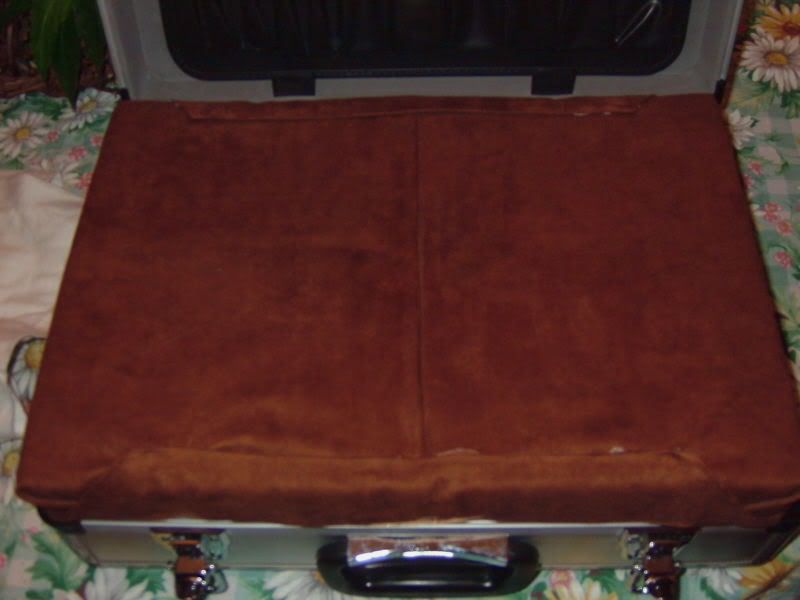
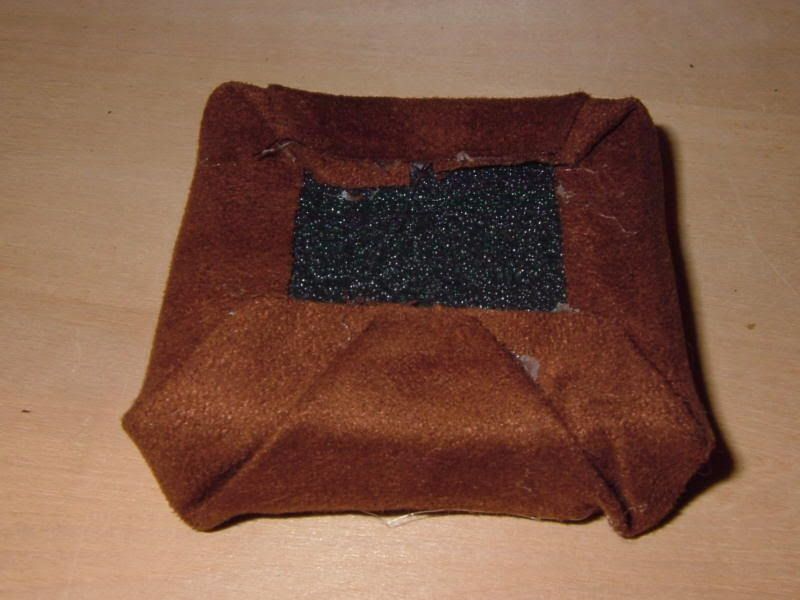
There was one final detail, not a necessity for full functionality, but to make it look better and improve long-term durability. The large "egg crate" foam pad in the top would eventually start to wear, tear and crumble if not covered. Got another half-yard of the Ultra-Suede fabric and completely covered it today. No real magic to it. A hot-melt glue gun, a little fabric trimming, and wrapping it up like wrapping a box with paper was all it took. Here's the back side, finished, and you can see how the cut edges are folded under to keep them from fraying. You'll also notice a bit of hot-melt glue showing in a couple places. No big deal, this side won't show unless I pull it out of the top.


Here's the "egg crate" foam pad, completely covered, installed in the top.


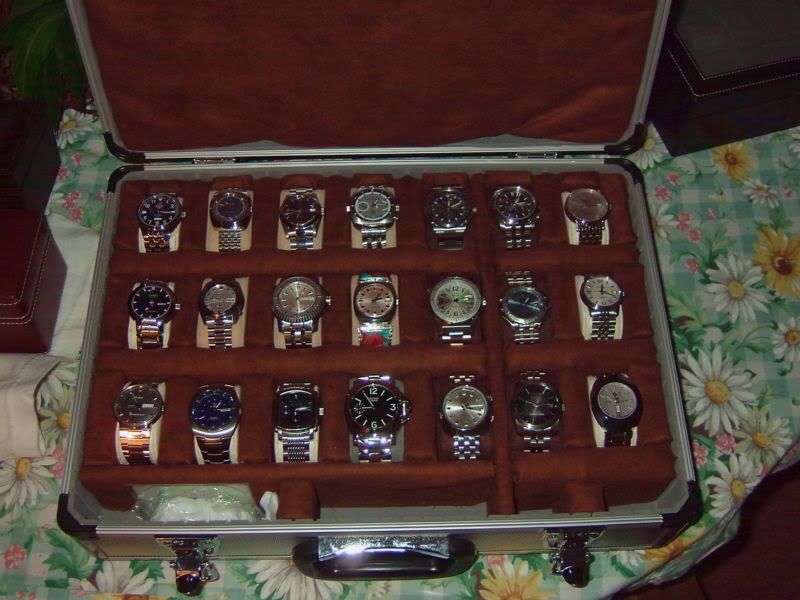
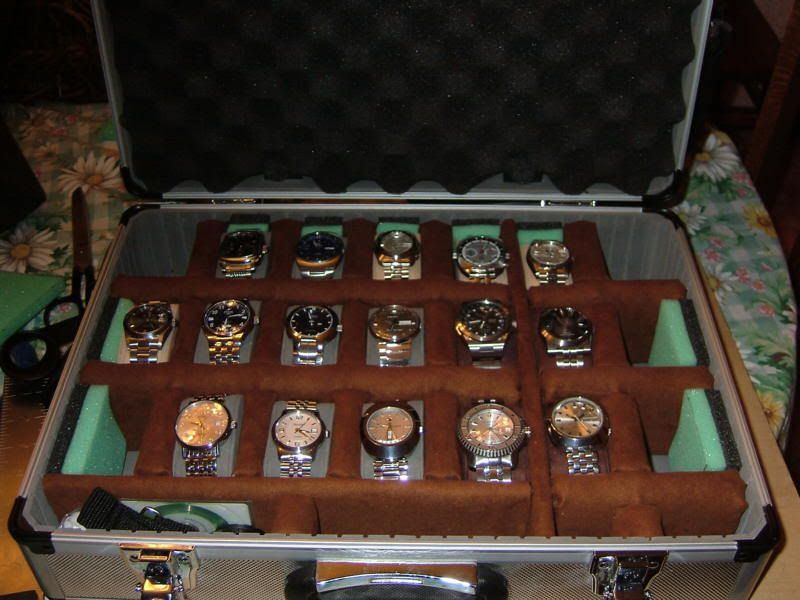
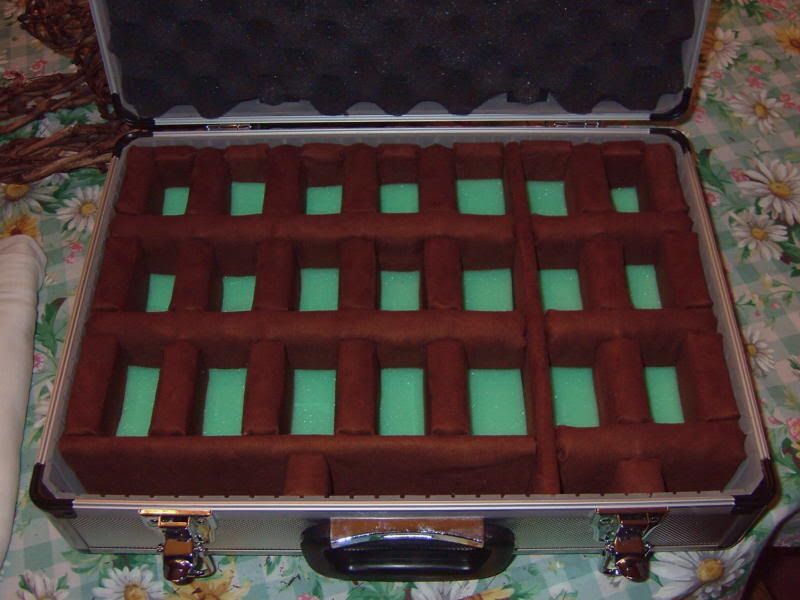
Finally, the complete box, with watches from different watch boxes placed into their pockets. Note the different colored watch pillows. One of the primary reasons for this mod was to avoid pulling watches off of the pillows on which they're normally stored in several watch boxes, and transferring them to foam pillows in this case. They're all on the pillows they would normally be stored on in their "home" watch boxes. Makes loading up the valise much faster and easier. Makes putting watches back into the watch boxes they're normally kept in much faster as well.


Now I'm FINALLY done . . . it's completely complete!

Part 9, Lowe's Tool Case Wristwatch Conversion

Padding the Sides


This has been a while in completion. Went on vacation for a little over a week and came back to a master bath that needed the vanity, counter top, sink and its plumbing to be ripped out again and completely reinstalled correctly. This included redoing some significant vanity cabinetry with modifications to make it fit properly. The installer who did the work while I was gone botched it completely. That consumed my evenings for over a week.

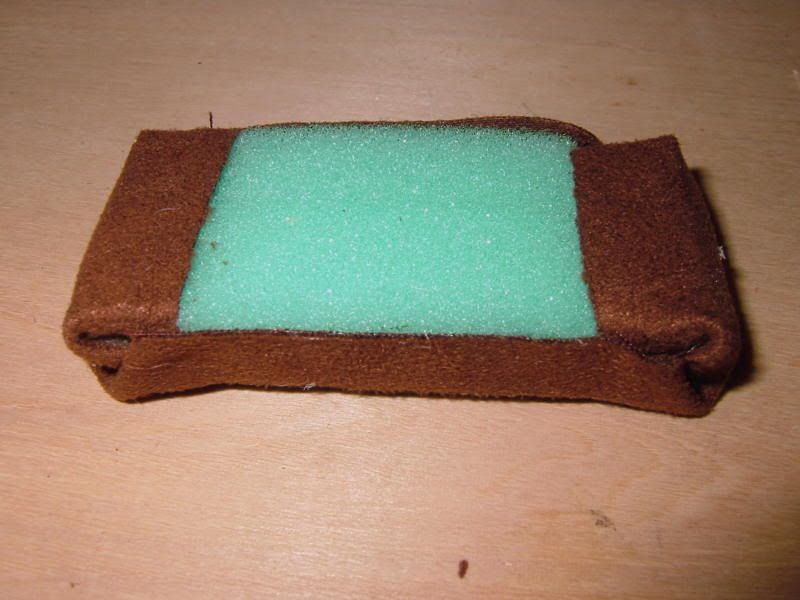
In the last installment, work had progressed sufficiently to make it mostly usable in the center pockets. However, padding around the outside edge, and for the bottoms of all the pockets needed to be made. The larger pads along the left and right sides needed some stiffness, so the medium density green foam was layered with some high density, very stiff (closed cell) foam. Used hot melt glue to layer the foam pieces. Lots of cutting and gluing to layer them together! This shows the outside edge pads nearly complete (without covering). The narrower pads along the back didn't need the additional stiffness, so a single layer of green foam was used for them.


After a lot more fabric cutting, the larger outer edge pads on the right and left sides were covered by rectangles of Ultra-Suede. Since the back sides of them would not show, they didn't need to be completely covered on the back. This shows some of the folding used as they were wrapped. Once again, hot melt adhesive worked quite well.


This is what the larger ones look like from the sides that will show when installed . . .


And this is how the fabric was folded around the narrower ones along the back . . .


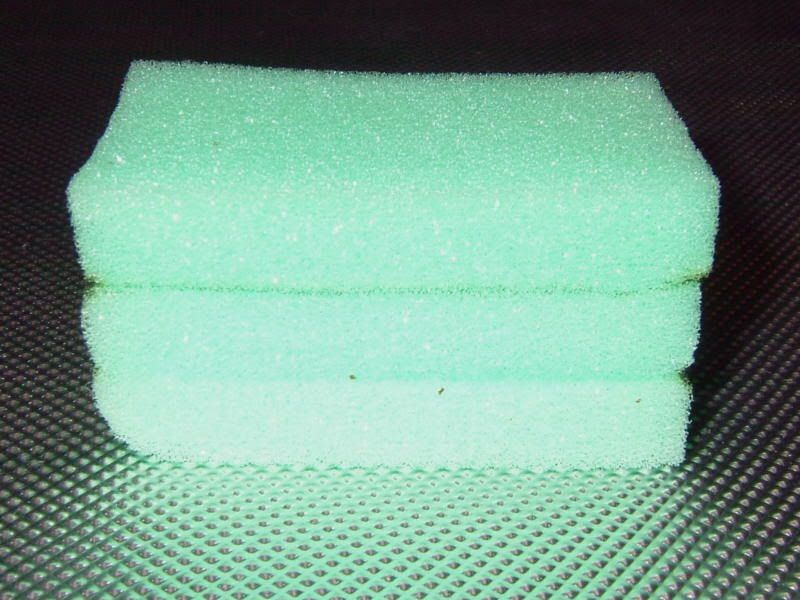
Now to make the padding for the pocket bottoms. The valise is deep; quite a bit deeper than necessary to hold watches. After measuring several watch pillows with watches on them and the depth of the pockets, three layers of medium density green foam should work to pad the bottoms of the pockets. A whole lot more foam cutting later (63 rectangles of foam for 21 pockets), they were layered together using hot-melt glue again. This shows one of the 21 pads for the pocket bottoms layered together. You can see some ink marks on it where the foam was marked for cutting. It was thin enough that I could use a pair of very heavy, long blade scissors designed for cutting aluminum window screen.


This shows how they will be installed into the pockets and they are intended to be a "friction" fit; just a hair oversize so they stay in place and don't fall out


Before covering them with Ultra-Suede, it's a good idea to see if all of them will fit properly!


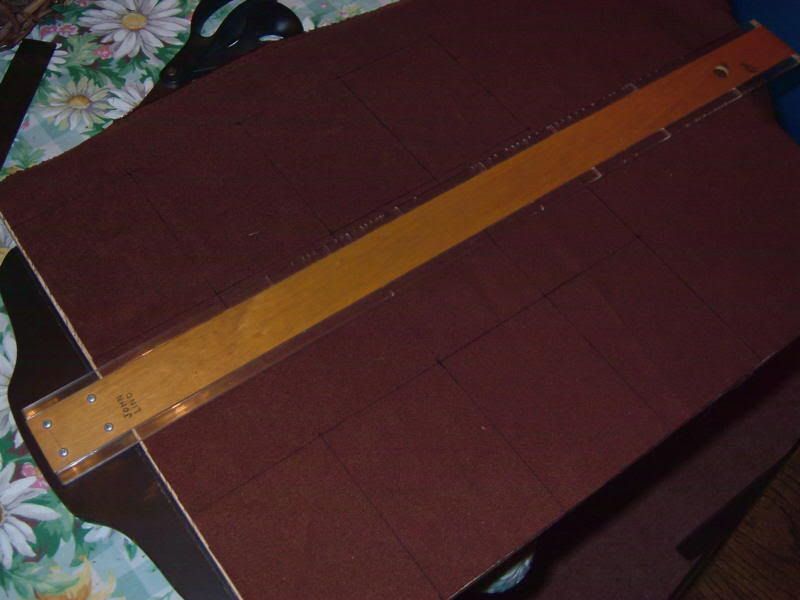
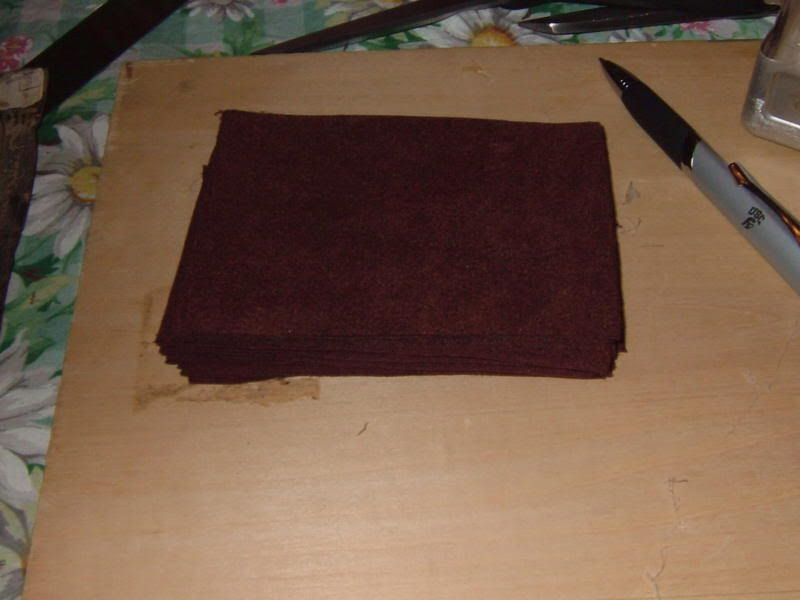
Yet more cutting of rectangles to cover the bottom pads. Used a small, portable drafting table, T-Square and 18 inch steel rule to mark the fabric on its back side for cutting.


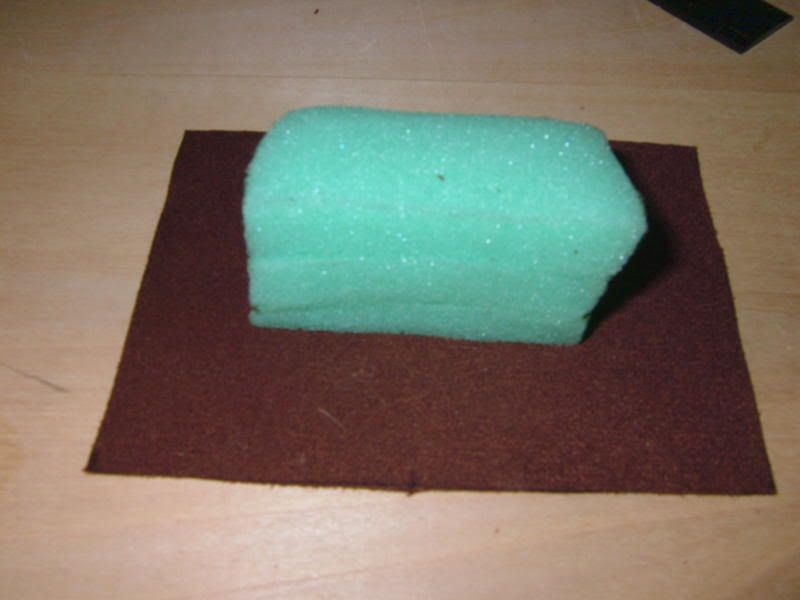
Now to cover the pocket bottom pads. Since the bottoms of them will not show, it isn't necessary to cover that side, just the top and at least half-way down the sides to hold the fabric in place. First step was very lightly gluing the top of the pad to the center of the fabric rectangle . . .


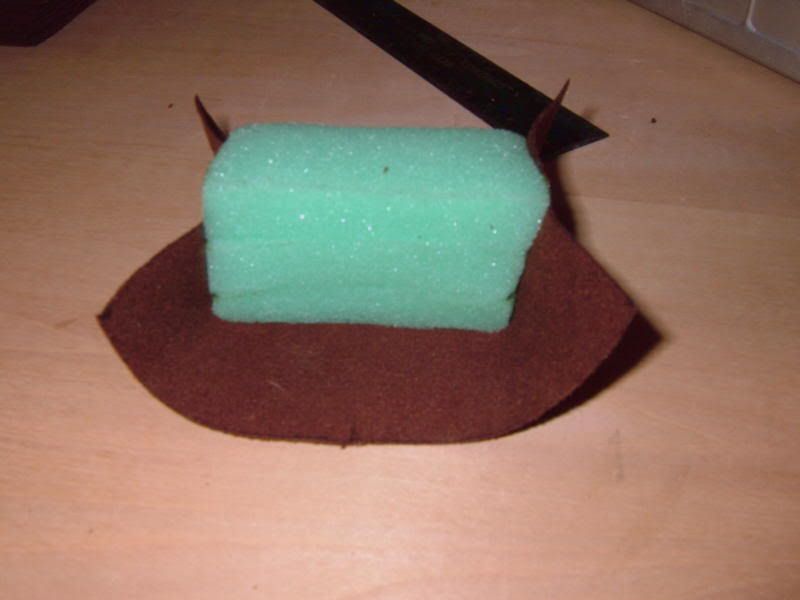
Next step was gluing the fabric onto the short sides of the pad . . .


After that, it was glued to the long sides of the pad . . .


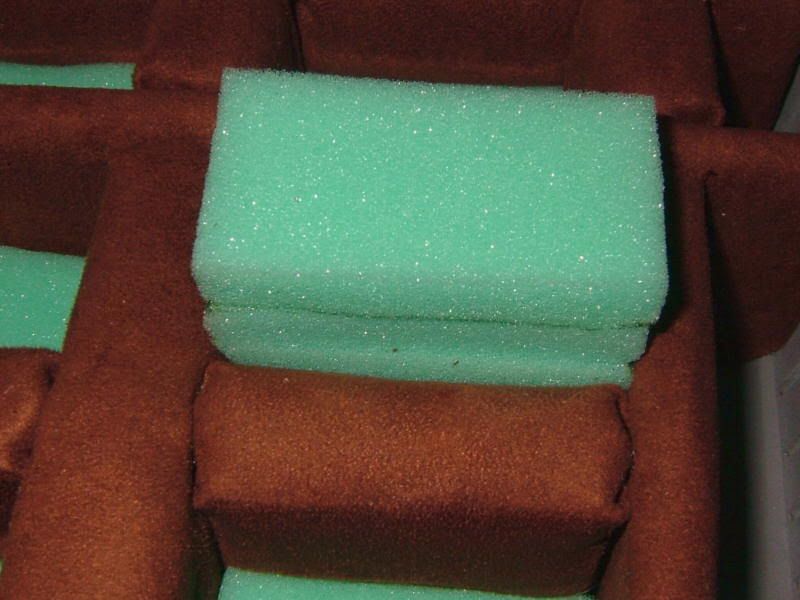
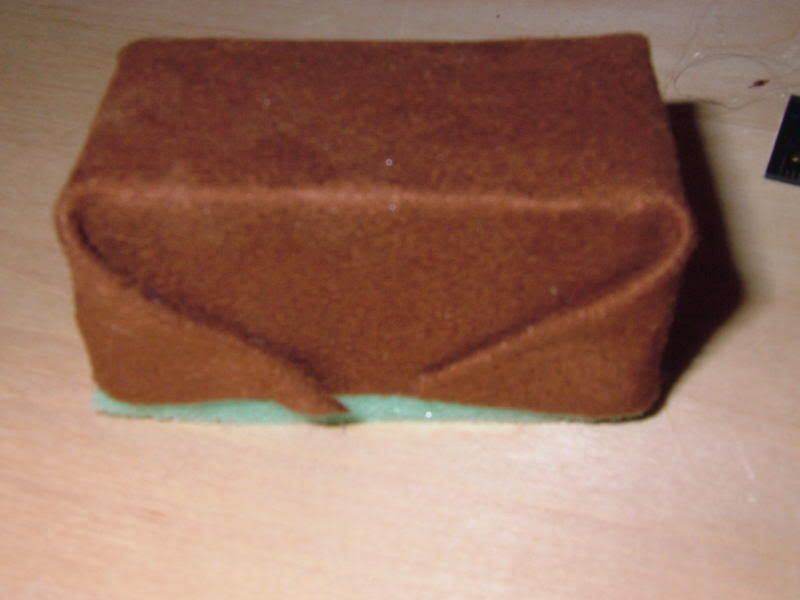
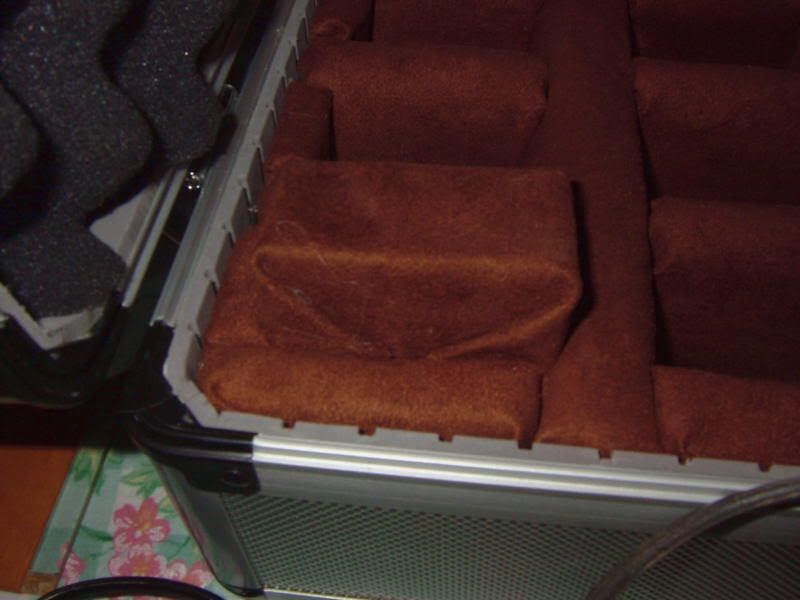
And then the corners folded around the long side and glued down; this shows the first of the 21 pads right side up and its Ultra-Suede covering completed.


Now to place it into its pocket . . .


And it's installed securely in the pocket bottom . . .


Only 20 more pads to go (the stack of cut fabric rectangles)!


Covering them took a little longer than expected. Had to take a little break about a third of the way through . . . a whole row completed now . . .


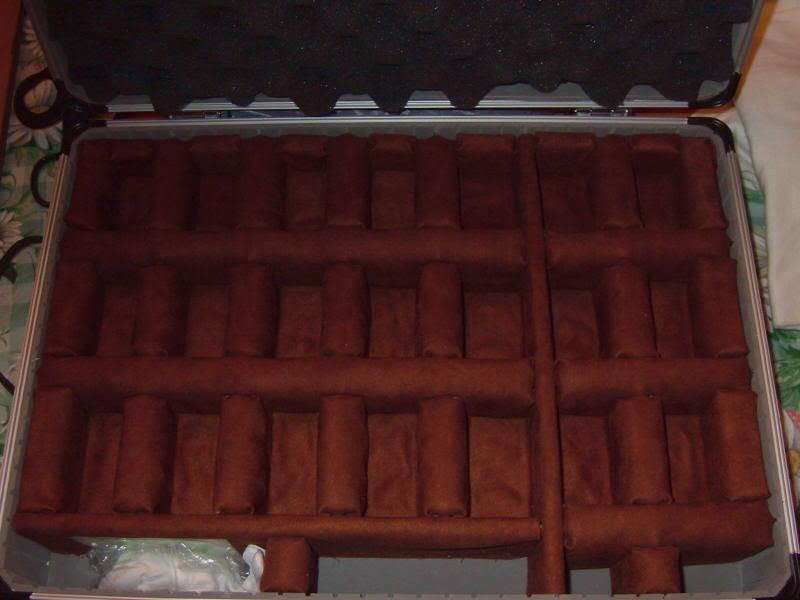
And finally they're all covered and in the pocket bottoms. Here it is, with everything finished!


At this point I'm declaring "victory" -- it's done! However, I do have some fabric left over, and will likely use it to cover the large piece of "eggshell" foam that goes in the top. Not an essential task, so I can take a rest from upholstering blocks of foam for a while :) When I do eventually cover it, it will be similar to wrapping a box with paper, and unlike the other small pads around and in the bottoms of the pockets, it will end up covered on all sides. The hot-melt adhesive worked extremely well and allowed working with things nearly immediately after gluing pieces together.

Swatch Group ETA Mechanical Movement Alternatives

Filling Swatch Group's ETA Mechanical Movement Void Sellita, Miyota, Soprod, and Ronda In 2002, Nicolas Hayek, then CEO of the Swatch Gr...