Showing posts with label Dive Watches. Show all posts

Friday, February 5, 2016

A Tool Watch Doesn't Have to Look Like a Tool

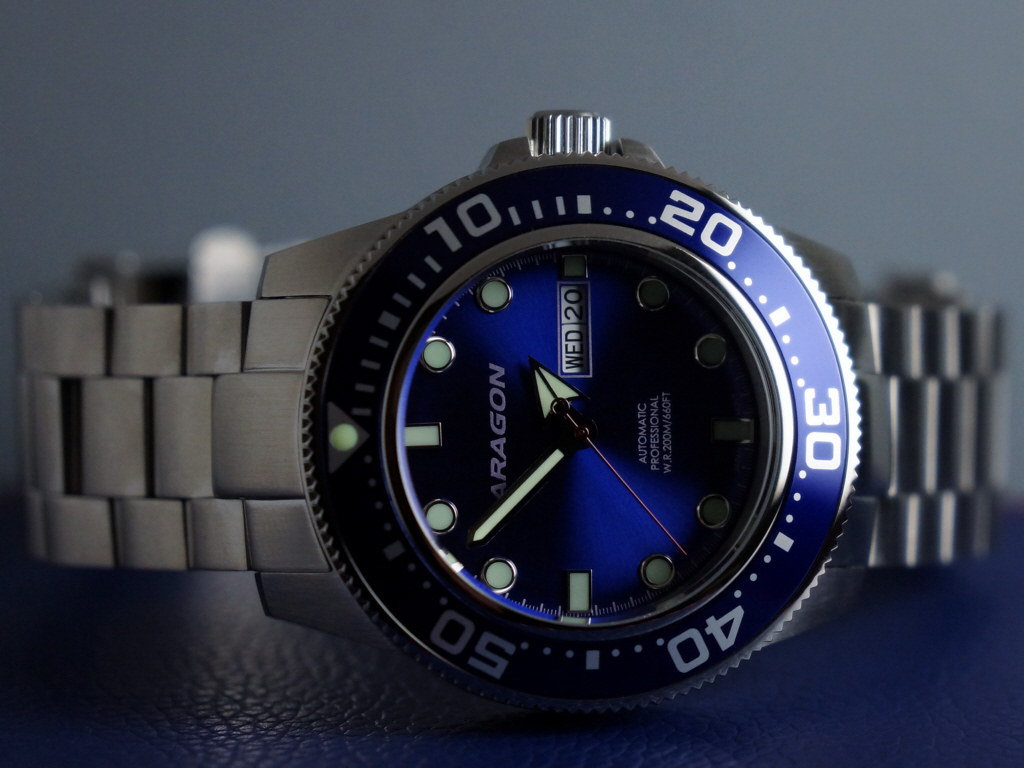
Aragon 45mm Divemaster Automatic
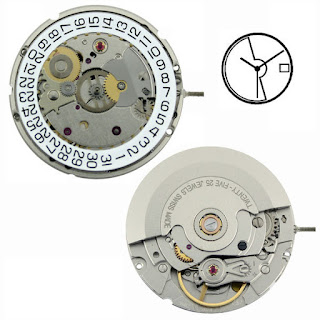
SII NH36A: 21.6 kbph 24j automatic with day/date complication
  • Reference #: A064BLU
  • Also offered in lime green and purple dials, and in a larger 50mm size
  • Mfr. year: 2016; current model and currently available
  • Case diameter: 45mm (without crown or crown guard)
  • Dial diameter: 30.5mm
  • Case thickness: 17mm
  • Lug-to-lug length: 50mm
  • Lug width: 22mm
  • Stainless steel case, crown, and back
  • Crystal: flat K1 hardened mineral glass
  • Back: Screw on with mineral glass display window
  • Bracelet: 4mm thick solid SS links, 22mm wide at lugs with no tapering
  • Clasp: signed double push-button z-fold with safety
  • Weight: 234 grams (with all bracelet links)
  • Movement: Seiko Instruments NH36A 21.6kbph mid-beat automatic with day/date complication and 42 hr power reserve
  • Diashock shock protection (per SII and Seiko specs)
  • Crown: screw-down 3 position push-pull for winding, quickset day & date, and time setting
  • Water resistance: 200 meters
  • Dial: Blue sunburst centered on the central hands with day/date window at 3.
  • Hands: Polished silver broadsword minute hand, short arrowhead hour hand, and dark red needle pointer seconds hand
  • Hour markers: Raised bold, broad batons at 3-6-9-12, and discs at the other hours
  • Lume: Hour and minute hands filled with lume along with the hour markers and a pip in the 0/60 minute wedge on the bezel ring
About Aragon Watch:
Aragon is a rebranding by OKO International in 2015 of what had been their Android brand of watches, founded in 1991 by Wing Liang. The trademarking of "Android" by both Wing (OKO Int'l) and Google wasn't a problem for some years as Wing made watches and Google made an operating system for cell phones. It's not that uncommon for a name to have multiple trademark holders so long as they're in different business and product sectors that prevents public confusion about who the trademark represents. The problem arose when electronics firms began designing and making "smart watches" using and/or interfacing with Google's Android O/S. Now both companies were in the business of watchmaking and both using "Android" related to watches would not work. The pragmatic solution for Wing was reaching an agreement with Google (et alia) and rebranding his watch line with a new name, Aragon. If there seems to be a strong resemblance in style between Android and Aragon watches, they have the same designer, Wing Liang. The Divemaster Automatic is one of six models that launched his new brand name in December 2015.
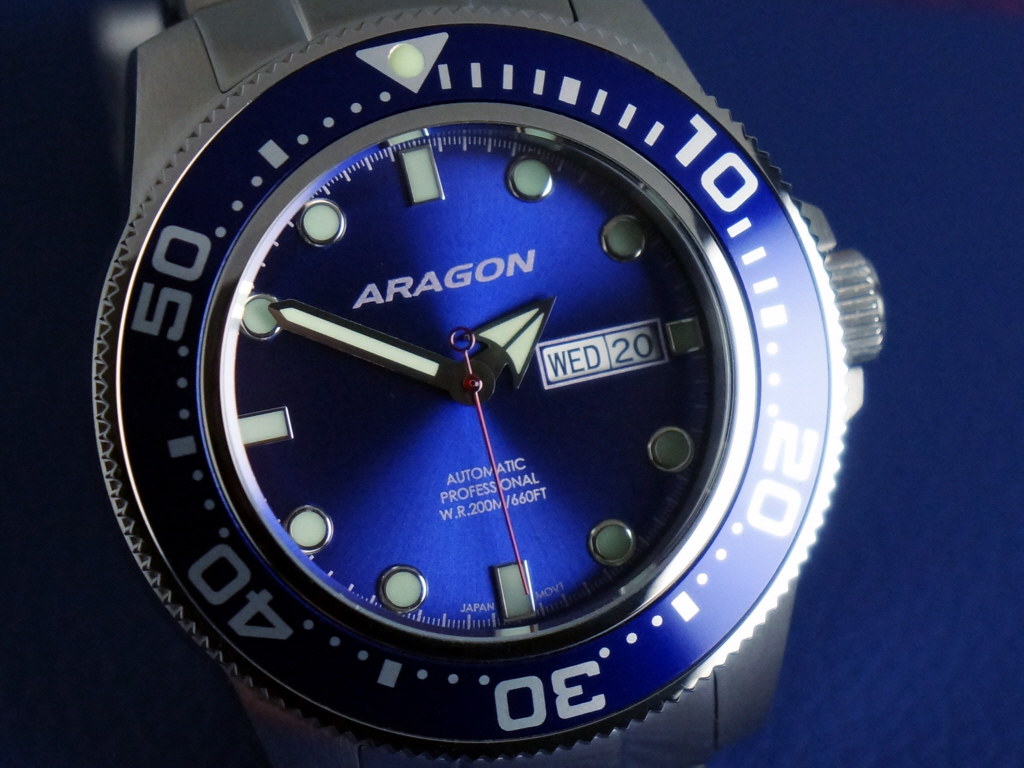
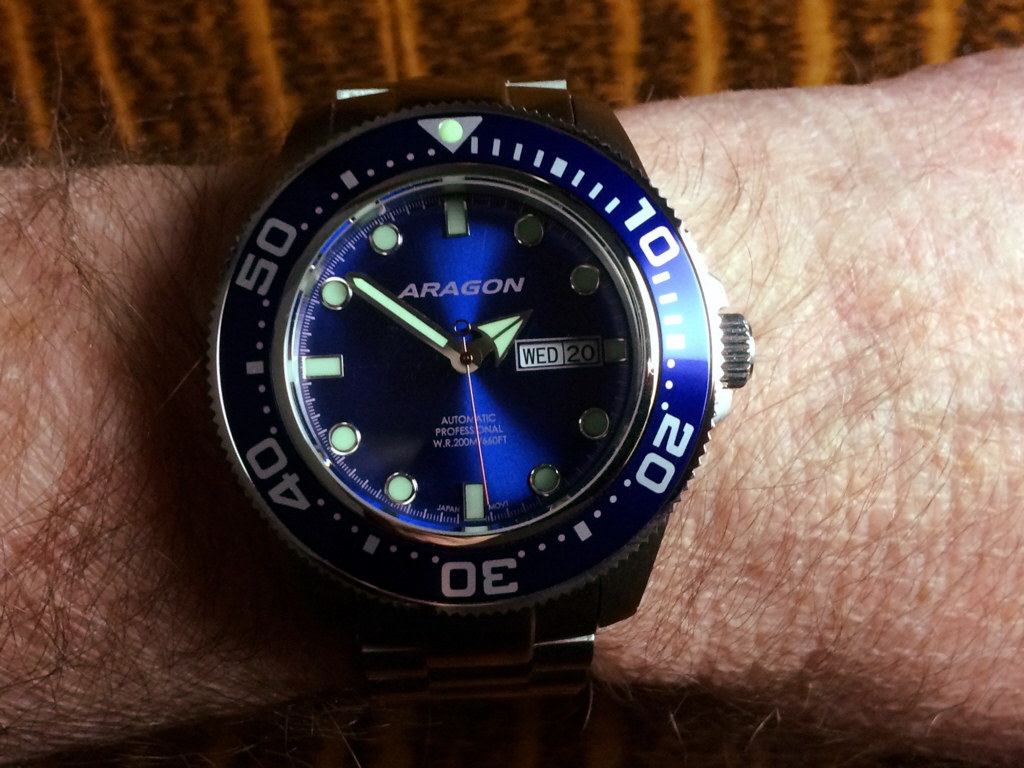
The 30.5mm diameter dial is a single layer with ultra-fine sunburst pattern radiating from its center. It's plenty large enough to see well without impinging on the width of the rotating dive timing bezel. The Aragon name and other labeling, along with the minute track is printed on it. A nice frame surrounds the day and date window. The broad, bold baton and disc hour markers stand proud from the dial. The long polished broadsword minute hand is beveled slightly which aids in maintaining visibility under different lighting directions. The bold and short arrowhead hour hand prevents any confusion between it and the minute hand, which is important for divers timing their dives. The central seconds hand is a fine pointer style in dark red, which provides significant color contrast to keep it from getting lost on the dial. Overall it has a simplicity that makes it very easy to read under all types of lighting without looking empty.

The 120-click rotating timing bezel in the same background color as the dial is smooth, firm and precise without any slop or lash, and it's unidirectional, as a dive timing bezel should be for safety reasons. It takes some definite torque to turn it, without any undue force required, which is also a Good Thing for divers. It's not going to accidentally get rotated very easily. The width of the bezel is in good proportion to the watch head and dial diameters, with nice bold, easy to read numbers and tick marks.

In a shade of blue slightly darker than the one commonly used in the Androids, the overall dial, hands and bezel design and layout get high marks for their unambiguous legibility.
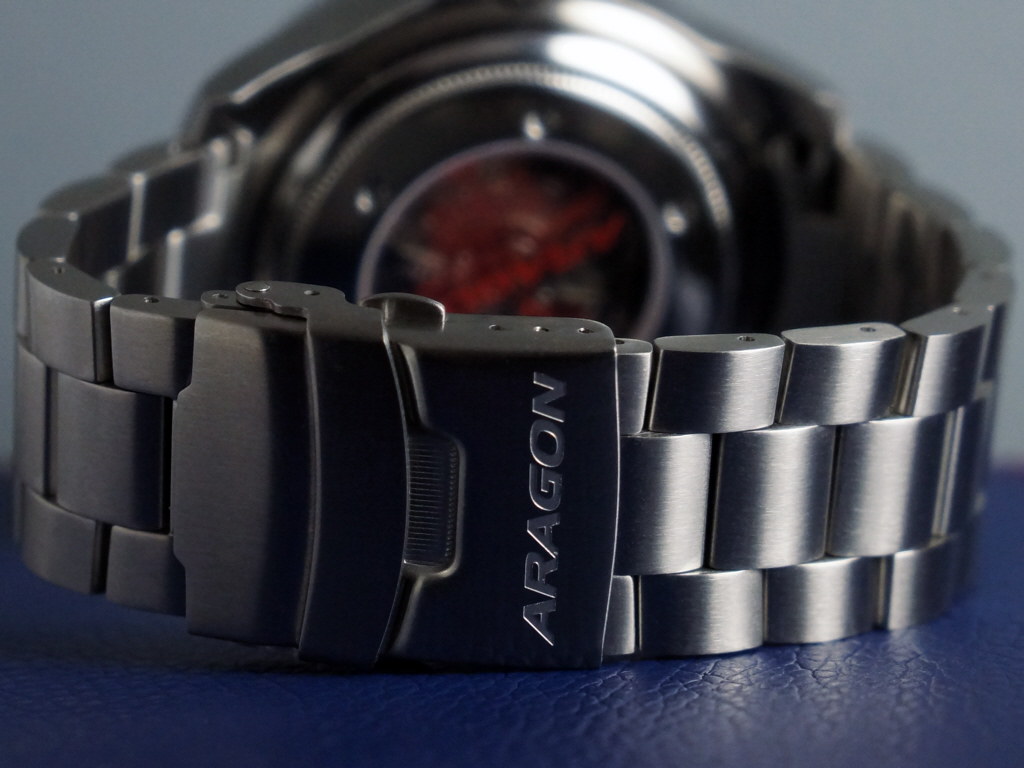

The brushed finish bracelet has solid machined links, including the end links that attach to the watch head and integrate very smoothly with the lugs. Clasp is a signed double pushbutton Z-fold with a safety and three holes for micro-adjustment of the bracelet length. While it's not machined steel, the clasp is very heavy gauge sheet metal. It's not going to flex or bend, even with some harsh use. Closure is firm and solid, including the safety. Links are held together with industry standard "split pins" and the links have arrows on the backside showing the direction in which to remove them. At 4mm thick and 22mm wide without any taper, the bracelet has enough heft to counterbalance the watch head.
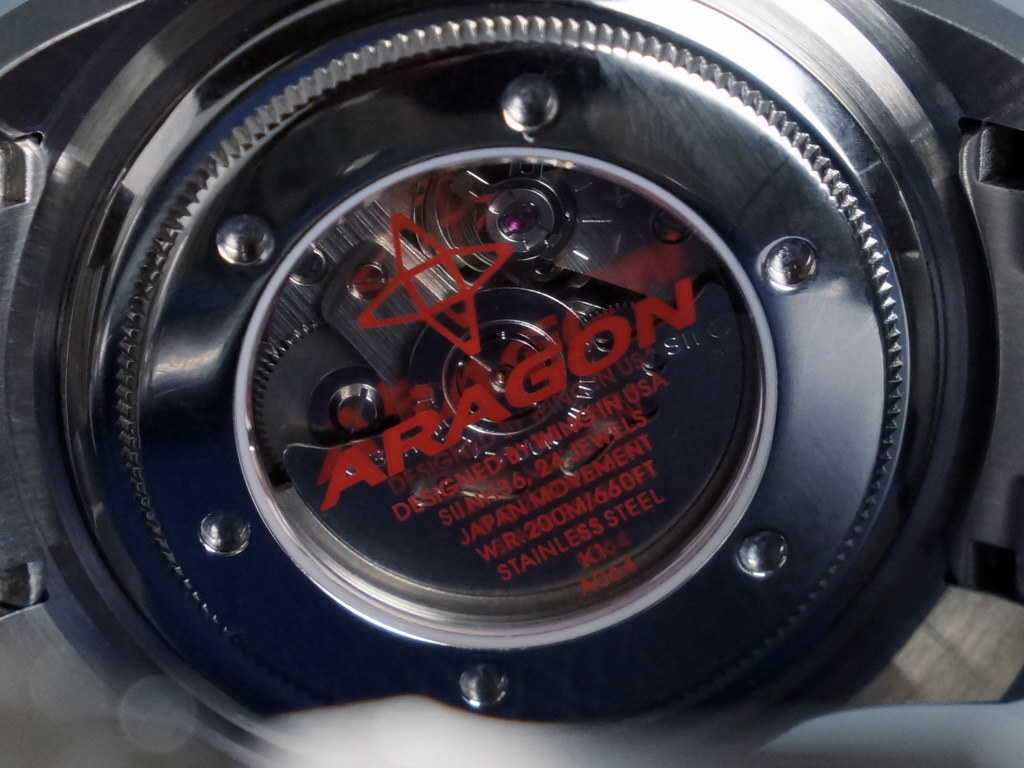

Movement under the dial is the SII NH36A, a caliber number SII and TMI use instead of the 4R36A caliber number Seiko Watch Company uses when they put the same movement inside Seiko branded watches. This 24 jewel, 21.6 kbph mid-beat is an evolution of the 23j 7S36, that includes hand-wind and hacking capability, and has the same ~42 hour power reserve with full wind. Even though the NH36A/4R36A is a relatively new movement, its design is based on a very mature and proven workhorse. In spite of the display back, it's undecorated, a "feature" that's pretty to look at and raises the manufacturing price of the movement (and hence, the watch), but doesn't contribute anything to reliability, durability, precision or accuracy. The one small nit I have with this watch is the Aragon logo and other data printed onto the display glass. Wing used to etch it into the steel frame around the display glass on the case back. Even though I used to sit and stare at the test pattern on TV as a young child (you have to be old enough to remember the test patterns - from when broadcast TV stations signed off the air at night for several hours), I don't stare at running watch movements, although a running balance is pleasing to watch for a short bit, so it's not anything significant. I did notice the back has holes for a case back wrench with round pins, and these are right in the middle of where the serial number and other watch data would be etched. The back wrench is less likely to slip out of these holes compared to the traditional shallow, rectangular edge notches found on most wristwatch backs. If that was the design trade-off, I'll go with the round pin holes for the case back wrench.
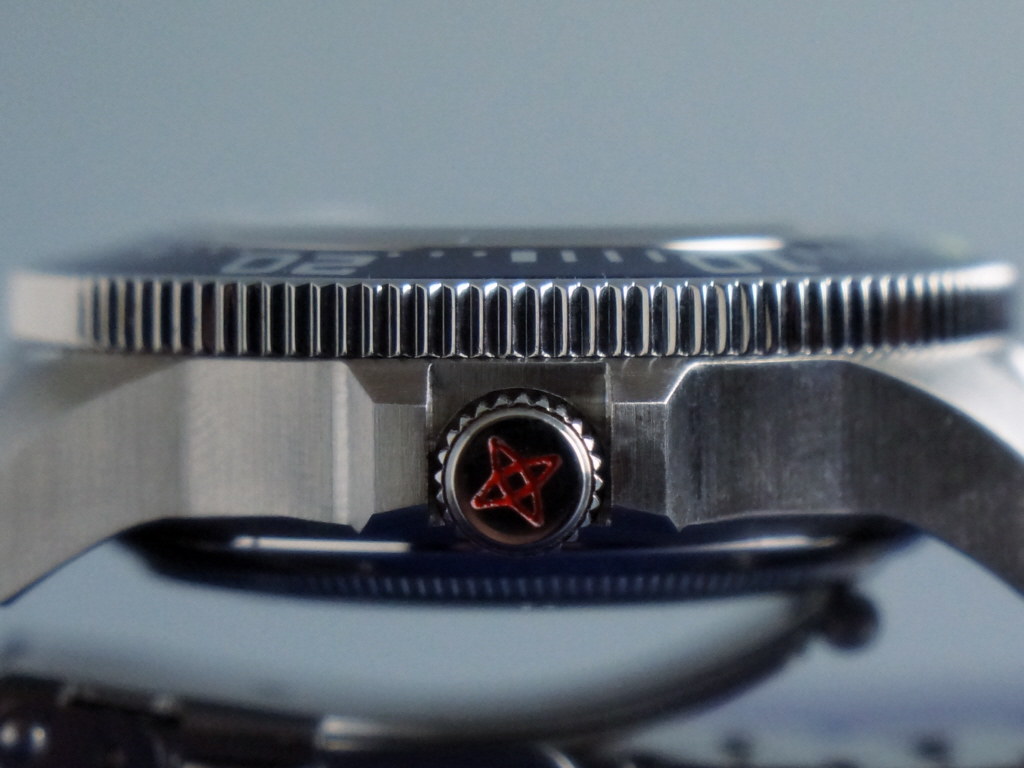

The Aragon logo in the signed screw-down crown is filled with red paint, a nice touch. The proportionally sized crown has good knurling with just a touch of radius added so that it doesn't feel jagged, allowing it to be screwed down, unscrewed and manipulated easily for winding and setting the watch, even with the ample crown guards around it. This is facilitated by the offset position of the crown relative to the crown guard. This offset allows it to be turned more easily and provides it with greater protection from above the watch, the most likely direction from which a blow to the crown would occur.

At 45mm diameter and 17mm thick, the watch head is not small, even though there are much larger watches now. It can still fit small wrists well in spite of its diameter with a 50mm lug-to-lug length that's not much longer than the main watch body diameter. The short lugs curve downward rapidly toward the wrist and away from the watch head, allowing the watch to wear "smaller" than its physical size. I have a 6-7/8 inch wrist (17.5 cm), which is not that large. This 45mm Divemaster fits on it quite easily without completely filling it, more easily than a couple slightly smaller diameter watches I have with longer, more horizontal lugs. It also fits under my dress shirt cuffs without any trouble, even with its 17mm height (your mileage may vary depending on how tight your shirt cuffs are).
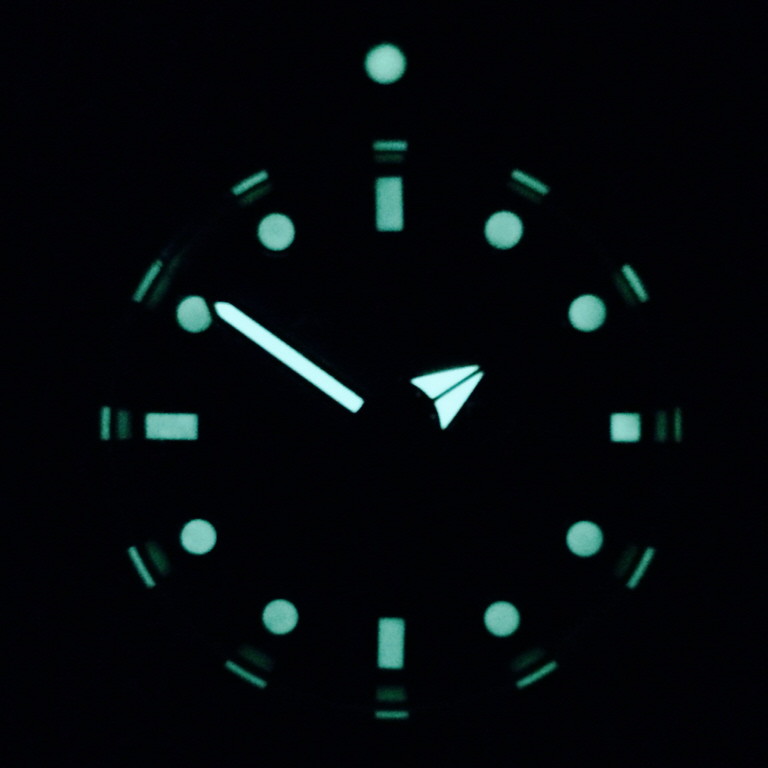
Lume is very bright with excellent persistence. The bezel ring has a lume pip in the middle of its index wedge. The hour indices are filled with lume making them bold and very visible. Likewise, the centers of the hour and minute hands are filled with lume, making them bold as well. The hands are slightly brighter than the hour indices and bezel pip, making them stand out more and keeping them from being lost visually in the rest of the lume.


Even though it's rated to 200m, I strongly recommend having it depth tested by a competent watchmaker equipped to do so before using it for diving. After that it should depth tested at least every two years as long as it continues to be used for diving. This is a sound safety practice not just for this watch, but for all watches and dive computers regardless of brand, depth rating, or water resistance reputation, if they're being used for diving.

In summary, the Aragon 45mm Divemaster Automatic is an attractive watch that maintains the traditional diving tool watch style, elements and principles: bold and highly legible hands, indices and timing bezel markings. It's comfortable on the wrist, even a smaller wrist, in spite of its size and mass compared to many other watches. It's an excellent model in Wing's relaunch of his watch business under the new brand name. Divemaster is a very fitting model name as it shows Wing's mastery of dive watch design. It demonstrates a functional tool watch doesn't have to look like it's just a tool; it can also be visually very attractive with style and class.

Note:
I have no affiliation, association or financial interest with the Aragon Watch brand owned by OKO International, its predecessor brand, Android, or any of their distributors or dealers.

Tuesday, August 28, 2007

Review: Tissot Seastar 1000

Tissot Seastar 1000 Automatic


Tissot is a Swiss watch making company founded in 1853 by Charles-Félicien Tissot and his son, Charles-Emile Tissot, in Le Locle, a small town in the Swiss Jura. Like most watch companies in the mid-19th Century, they made pocket watches. By the end of WWI they were making wristwatches as the popularity of them rose during the war. Their first round of financial troubles resulted in a merger with Omega in 1930 that created SSIH. The merger was financial and governance in nature. Both brands retained their own unique identities and product lines afterward.

During the early 1980's, Tissot was among a number of companies pulled under the umbrella of The Swatch Group which was formed by the Swiss banking industry and government to save the Swiss watch making industry from financial collapse caused by the onslaught of inexpensive quartz watches made in Japan. They are financially independent of the other watchmaking companies and brands within the group, and must maintain their own viability. Their financial stability has gradually improved over the past 30 years. During the late 1980's, Tissot made watches from unusual materials including rock, mother of pearl, and wood. While they were more of a fad, it showed Tissot's imaginative thinking and willingness to take some risk to try unusual concepts. Within The Swatch Group, Tissot is classified as a "mid-range" brand along with numerous others including Balmain, Hamilton and Mido.

While Tissot started as a "Manufacture" (making their own movements), they have been an "Assemblage" for several decades, and the watch movements they use now, both mechanical and quartz, are made by ETA, a movement maker in The Swatch Group. ETA has a long and renowned history of designing and making high quality watch movements. Tissot has an international market presence with wider international brand recognition, including within North America, compared to a number of the other Swatch Group brands.

Although they make a range of styles, their primary focus in the past few years has been sports watches, many of which are associated with car and motorcycle racing. They are the official timekeeper for NASCAR, and Danica Patrick, a well-known Indy Racing Leauge (IRL) driver is one of their "ambassadors," which has improved brand visibility in the USA. Others in their collections like this Seastar are associated with diving.

The presentation box the Tissot Seastar 1000 comes in is more than impressive. It goes above and beyond most packaging materials and workmanship quality I've seen used for watches in its price class, with a special compartment in the bottom containing a good sized book about Tissot and their history.

At 44mm x 52mm x 16mm and 180g it's Gargantuan and massive, especially compared to nearly all my other watches. The only other one in my collection that rivals its size and weight is the IWI Marine Diver (not quite as tall, but heavier). The lug width and heavy band is 22mm wide. A "true" diver, it's rated to 300 meters (1ooo feet) with a very solid and heavily protected screw-down crown, and a thick bezel.

My wrist is modest and this one definitely covers it completely. I knew its dimensions when I bought it and there was some concern it would look much too big for it. However, Tissot did a marvelous job designing its lugs, bracelet attachment and scaling the Seastar 1000. The lugs slope downward more than on most watches and the bracelet falls off around the wrist naturally. Every element is scaled so that no elements look unnaturally larger than the rest, a very pleasant surprise as macro-photographic perspectives can only hint at this.

Workmanship, fit and finish are immaculate. The polished areas are mirror finish and the brushed areas match texture throughout. The sapphire crystal is noticeably domed . . . more so than the others I have . . . without a "cyclops" magnifier. It doesn't need one as the crystal is a slight magnifier and date is easily readable.

The silver dial has a magnificent ultra-fine sunburst texture with high polish silver applied indices that do not get "lost" as they stand boldly proud above the dial. Of special note is the chapter ring with half-minute marks; this is the only watch I've seen with 30-second intermediate and shorter hashs around the dial. Printing is clean and straight with very sharp edges. Hands are bold without being so bold as to cover too much of the dial and the red tip on the seconds hand is a nice touch that makes it easier to see.

Lume is bold, bright and even throughout, on the hands, just outside the indices, and on the bezel ring. The bezel ring has one-minute detents and is very smooth with positive detenting that feels solid without any wobble or rattle.

Some may not like a display back on a diver, but this doesn't bother me. It has a "porthole" look embedded into the back held on with screws. Slightly off-center, the SCUBA diver and Tissot logo show on the decorated auto-wind weight when it's oriented in the correct position. The movement is a 25 jewel high beat 28.8k bph ETA 2824-2 automatic with date complication. As this ubiquitous movement is so well known, I won't say more about it here.

The solid machined links on the bracelet are thick and heavy to counter-balance the weight and scale of the watch head. Signed clasp closure is very positive without being hard to work and conceals a dive extension with equally positive closure. Removeable links have "split pins" and these were much harder to remove than with others I've resized. While this may be one downside and make resizing the bracelet difficult, it also indicates the pins will not work themselves out over time.

The signed crown screws down smoothly and the detents for date quick-set and setting time are positive. Knurling on the crown and bezel should make them easier to operate with light gloves on than with most watches. The crown guard fits the style of the rest of the case nicely and is a very desirable feature to protect the large crown without making it difficult to unscrew and use to set the watch.

Once I had the bracelet adjusted properly, the watch feels very comfortable and balanced on the wrist even though its high mass can't go unnoticed. The secret is removing the proper number of links from each side to keep the hidden z-fold of the clasp centered under the wrist when the watch head is centered over the wrist.

Overall Impression:
This is a phenomenal watch for its price point. I don't consider it a true "tool" watch although it could certainly be used as one. It's simply too beautiful to subject it to what diving would undoubtedly do to its case and bracelet finish! This is a watch that wants to stay beautiful! Those bothered by very large and heavy watches on their wrist should find a different watch; this one isn't for them. However, for those that do wear larger and heavier watches, don't dismiss the Tissot Seastar 1000 based on its much larger than normal dimensions and weight compared to other divers. You would be pleasantly surprised that it doesn't look or wear oversized. Tissot ordered up a "diver," told their designers to make it Biggie Size, and that's just what they did; very, very well!

It fits my modest wrist just fine!Tissot's Web Site
Note: I do not have any association with The Swatch Group, Tissot or their dealers other than having bought a Tissot from an authorized dealer.

Sunday, August 26, 2007

Review: IWI Marine Diver Unitas

IWI Marine Diver Unitas


Summary:
  • 44 mm diameter
  • 52 mm length lug-to-lug
  • 13 mm thick
  • 24mm wide X 4 mm thick solid screw link stainless steel band
  • 250 grams
  • ETA (Unitas) 6497-1 21 jewel 18,000 bph movement
  • Sandwich lume, high gloss deep black dial
  • Stainless steel case, crown and back
  • Heavy screw pin band attachment
  • Sapphire slightly domed crystal with underside AR coating
  • Sapphire display back
  • Lock down crown and butterfly clasp with pushbuttons
  • Seconds sub-dial
International Watchman, Inc. is a small company located in a suburb of Cleveland, Ohio. Like a number of very small watch companies in the U.S., they are technically a "Private Label" firm. The watches are custom made for them with IWI's name and logos by an "Assemblage" in Switzerland.

IWI has quite a range of mechanical watches. While a few "dress" models are offered, most of them are Diver, Pilot or Quasi-Military styles, including a line of GMT variants. They offer many more models and variants than most other watch companies of similar size, including a good number of Women's watches. IWI uses excellent materials, including Swiss Made ETA movements in all their watches. Their entire offering appears to be mechanical; browsed through their catalog and could not find any battery powered quartz models (including in the Womens' models and in their "Dress Watch" line). This one is the "Marine Diver Unitas" with silver hands and it's on an optional (at extra cost) stainless steel band. It comes with a see-through "display back" that allows viewing the mechanical movement inside.

Although it's not the largest watch they make, the Marine Diver Unitas is still quite BIG! It's the first thing noticed when opening the box. A 44mm case diameter on a cushion style case with a comparatively thin bezel and very large crown guard that protrudes 6mm from the side of the case to completely surround the crown makes for a watch that looks even larger than its dimensions. Other case dimensions: 52mm from lug tip to lug tip, 13mm height, and 24mm band width between the lugs. Case, crown and bezel are made of solid 316L stainless steel. Both crystals (top and back) are sapphire, and the top crystal is very slightly domed with an AR coating on its inside to reduce reflections. A watch head this size made of these materials will be quite heavy; it's over 250 grams. Dial is an extremely high gloss, deep "India Ink" black color. The dial is actually a "sandwich" with its very bold hour indices in arabics and batons cut out in the upper dial much like a stencil. The lower dial under it is coated with luminescent paint (either Luminova or Super-Luminova). This design gives the dial a unique 3-D appearance different from most other watches. The hands are highly polished silver color batons with a wide center stripe of Super-Luminova (variant models have gold hands or blued steel hands).

The overall concept for the Marine Diver Unitas is derived from the large wristwatches used by the Italian Navy (Marina Militare), notably by their special manned torpedo commandos of the 1a Flottiglia Mezzi d'Assalto formed just prior to WWII in 1938. Two years later in 1940, at about the time Italy joined WWII, its designation was changed to Decima Flottiglia MAS. The Italian navy was the first to use "frogmen" and human guided torpedoes. These SLC (Silura a Lenta Corsa; Slow Running Torpedo) commandos would be transported to their target area by submarine. Once released from the sub, each torpedo (called chariots by the British) with a crew of two would ride it to their target, detach its limpet mine warhead, and attach it with a timer on the targeted ship. The crew would then use the torpedo to ride back to the submarine.

Although their daring was high, their success rate was low with a very high casualty rate. Even so, for the small size of Xa-MAS during the war, they managed to sink over 200,000 tons of Allied warships and merchant ships from 1940 through 1943 prior to Italy's armistice with the Allies. Although some of the commandos stayed with the German military until Germany's surrender in 1945, SLC manned torpedo operations ceased in 1943 with the armistice. Italian commando units were formally disbanded and banned at the end of WWII, but the Xa-MAS was resurrected when Italy joined NATO in 1954. A number of nations, including Italy, continue to make and keep manned torpedo commandos, and train commando crews for them.

I opted to have my Marine Diver Unitas delivered on the optional 24mm wide, very thick, solid 316L stainless steel band with machined links. Each link is actually two pieces held together with a pair of flush machine screws on the underside; one part has a high polish mirror finish and the other a brush finish. The band is attached to the watch head using heavy screw pins, and removable links have screw pins and center tubes. Don't drop and lose any tubes when resizing the band; they fall out of the link centers easily when the screw is pulled! Clasp is a hidden butterfly deployant with positive closure and tabs on each side that must be pressed inward to open it. The steel band also comes with a pair of "half links" about 2/3rd the size of a normal link. This allows resizing in 1/3rd link increments by using one, both or neither of them. It also came with a "stock" leather strap (minor upgrade to crocodile) and I had a butterfly deployant (also an option) placed on the strap for delivery. Put the leather strap on the watch head briefly to size it, and it installed easily. While the strap is impressive and quite well made, as is the very solid deployant, I prefer steel bands over leather on my watches. Even so, I may swap between the two occasionally in the future. In spite of its size, it wears well on my smaller size wrist very comfortably, even with the very large crown guard. The trick to wearing a hidden butterfly clasp without it digging into the wrist is proper band sizing, and adjusting its exact location. I tweaked this for a half day using the 2/3 links to micro-adjust its size, and by moving a link from one side of the band to the other.

The large case size is needed to house a 17 jewel 18,000 bph ETA 6497-1 hand-wind with an impressive 56 hour power reserve from full wind. Doesn't seem like much except the movement was originally created by Unitas in 1950 for pocket watches, hence the "Unitas" in the watch name. Mens' pocket watch movements are not small. The ETA 6497-1 is 16.5"' (Ligne, 1/8th of the old French inch), a very old measure of movement diameters still in use. That's 36.6 mm in diameter; it's also 4.5mm tall not counting a dial and hands. Add a few millimeters all the way around around its diameter for a steel case to house it and whatever watch is going to use one is easily over 40mm diameter. ETA gained rights to Unitas' movements when they absorbed Unitas (and several other movement makers) during the latter part of the 1970's when The Swatch Group was formed to save the Swiss watchmaking industry financially. ETA kept Unitas' movement caliber number and it's still often referred to as the Unitas 6497 even though it's made now by ETA due to widespread recognition of it's original "brand identity." That a movement designed in 1950 is still in production nearly 60 years later without any significant redesign is a testament to its exceptional performance, durability and reliability.

Execution, fit and finish is excellent. The case is highly polished, the crystal is extremely clear (due to its AR coating), and the crown lock is firm and very positive in closure without binding. Dial and hands are impeccable in finish; difficult to achieve with a deep black high gloss dial finish. Out of the box it's running slightly fast, about 5 seconds per day, common for a new movement until its pivots wear in, which takes a few months of daily use. The huge, solid wood box the watch came delivered in is the largest and heaviest I've encountered. It's equally well finished with size and weight in keeping with the watch it contained. All are befitting a wristwatch in its price class and I've been quite impressed with it. The IWI Marine Diver Unitas is not a "true" dive watch as its water resistance is rated to 50 meters, nor is it intended to be. It's a "desk diver" with its concept derived from the watches used by the Italian Navy decades ago. A real dive watch is rated for 200 meters or more water resistance, and if used for diving, or even swimming, should be depth tested annually.

International Watchman does not publish a price list on their web site beyond pricing for bands and other accessories, and they do not have a published MSRP. Their business is geared for wholesale sales to department stores, and brick & mortar jewelry stores which set their own pricing. Depending on options (steel band, exotic leather band upgrade, etc.), and specific variant, retail prices among dealers for the Marine Diver Unitas are usually well under $1000.
Summary:
  • 44 mm diameter
  • 52 mm length lug-to-lug
  • 13 mm thick
  • 24mm wide X 4 mm thick solid screw link stainless steel band
  • 250 grams
  • ETA (Unitas) 6497-1 21 jewel 18,000 bph movement
  • Sandwich lume, high gloss deep black dial
  • Stainless steel case, crown and back
  • Heavy screw pin band attachment
  • Sapphire slightly domed crystal with underside AR coating
  • Sapphire display back
  • Lock down crown and butterfly clasp with pushbuttons
  • Seconds sub-dial
International Watchman Inc. Web Site
Note: I do not have any association with International Watchman other than having bought one of their watches and several accessories for it (delivered with the watch).

Swatch Group ETA Mechanical Movement Alternatives

Filling Swatch Group's ETA Mechanical Movement Void Sellita, Miyota, Soprod, and Ronda In 2002, Nicolas Hayek, then CEO of the Swatch Gr...